 BTC
 ETH
 USDT
 BNB
 XRP
 USDC
 SOL
 TRX
 FIGR_HELOC
 ZEC
 HYPE
 DOGE
 XMR
 USDS

Litecoin (LTC) Price Today: LTC Tests $75 Resistance as RSI Signals Pullback Risk
Litecoin’s September rebound is pushing LTC toward the $75 resistance zone, but increasingly overbought momentum is raising questions about whether the rally can continue.


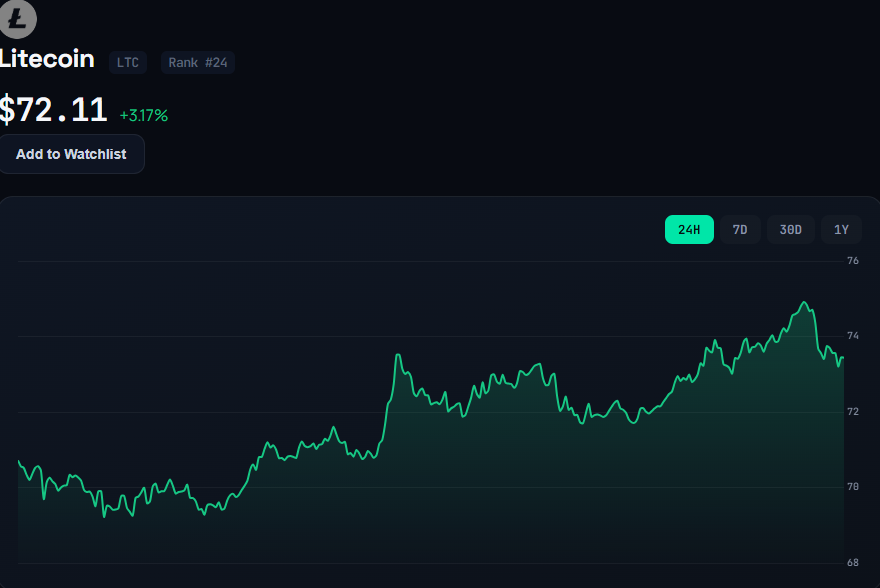
Litecoin (LTC) has extended a sharp September recovery, bringing the cryptocurrency back toward the $75 area after spending much of the month below $65. On September 24, LTC climbed from around $62 to an intraday high near $75 before consolidating. Binance historical data shows LTC trading around $73 on September 26, while the September 24 session recorded a high of about $74.83.
The move has materially changed the short-term Litecoin price analysis. LTC is now trading well above several shorter-term moving averages, while trading activity and on-chain transfers have increased. At the same time, the rapid advance has pushed daily momentum indicators into overbought territory, creating a technical conflict between strong trend momentum and the possibility of a near-term pullback.
Litecoin Tests $75 After 40% Monthly Rally
The recent rally has been unusually strong. LTC traded near $51.66 on September 16 before climbing above $70 within a little more than a week. Historical data shows a September 24 close around $71.95 after the cryptocurrency briefly reached $74.83.
That places the $75 region at the center of the current LTC price discussion. The level has acted as an immediate reaction zone after the latest surge, and a sustained move above it would represent another step away from the 60-65 range that contained Litecoin earlier in the month.

Recent market coverage also identified $75 as the next major resistance after LTC moved through the 64-65 area. One technical analysis placed the following resistance near $78.13.
However, resistance should not be interpreted as a guaranteed reversal point. Crypto markets can remain overbought for extended periods during strong trends.
Overbought RSI Raises Pullback Risk
Momentum is one of the strongest parts of the current Litecoin setup, but it is also the main reason for caution.
The supplied technical readings place Litecoin’s daily 14-period RSI around 83, well above the commonly watched 70 threshold for overbought conditions. An RSI at that level does not automatically mean LTC must decline. Instead, it indicates that price has advanced rapidly relative to its recent trading range and that consolidation or a retracement becomes increasingly relevant.
Other technical indicators remain constructive. The daily EMA structure reportedly has the 9-period average above the 21-period and 50-period averages, while MACD remains positive and ADX is around 50. Those signals generally point to an established trend rather than a market that has already lost momentum.
The distinction matters for any LTC prediction. Overbought momentum can coexist with a bullish trend. A pullback toward support would therefore not necessarily invalidate the broader recovery.
66-68 Support Becomes Important
With LTC trading near the upper end of its recent range, the 66-68 area becomes an important reference zone.
This region sits below the current market and around levels associated with the recent breakout and short-term retracement structure. If LTC retreats after testing $75, traders are likely to monitor whether buyers defend this area.
A deeper correction could bring the 60-62 region back into focus. That zone was important during the consolidation that preceded the September breakout. Historical data shows LTC trading near 59-64 between September 20 and September 23 before the sharp September 24 advance.
The technical picture would become less constructive if LTC were to lose these support areas decisively. Conversely, holding above them would leave the recent higher-high structure intact.
Network Activity Adds Fundamental Context
Price momentum has not been the only development attracting attention. The Litecoin Foundation reported on September 23 that more than 17 million LTC, representing over $1 billion in value, moved across the network within 24 hours.
That figure requires some context. On-chain transfer volume measures Litecoin moving between addresses; it does not mean that $1 billion of new investment entered LTC. Transfers can include movements between exchanges, custodians, and other wallets.
Still, the increase in network activity provides additional context for the recent rally. Litecoin’s market capitalization was around $5.5 billion in late September, according to historical market data, meaning the reported network activity was substantial relative to the asset’s overall market size.
The Litecoin Foundation has also described MWEB as an optional technology that provides additional transaction confidentiality. Unlike privacy-focused cryptocurrencies whose primary design centers on anonymity, Litecoin’s base layer remains transparent, while MWEB operates as an optional extension.
Litecoin ETF Developments Remain Relevant
Institutional access is another factor behind the renewed interest in Litecoin.
Canary Capital’s Litecoin ETF, trading under the ticker LTCC on Nasdaq, already provides exposure to LTC and holds Litecoin directly. Canary’s own fund information lists an October 2025 inception date and describes the product as a passive vehicle designed to track the price of Litecoin before expenses.
Grayscale is also pursuing a separate ETF conversion. A September 2026 SEC filing states that Grayscale intends to rename its Litecoin Trust as the Grayscale Litecoin Trust ETF in connection with a proposed NYSE Arca listing. The filing describes the trust’s purpose as holding LTC.
These developments do not establish that ETF-related demand caused the September rally. They do, however, show that Litecoin has gained additional regulated investment-product infrastructure.
EU Privacy Rules Need Careful Interpretation
Some market commentary has connected Litecoin’s optional MWEB privacy feature with forthcoming European anti-money-laundering requirements. The underlying regulation is real, but several claims circulating in crypto commentary require qualification.
Article 79 of the EU’s Anti-Money Laundering Regulation prohibits credit institutions, financial institutions, and crypto-asset service providers from maintaining anonymous crypto-asset accounts or accounts that allow transactions to be anonymized or significantly obscured, including through anonymity-enhancing coins. The regulation defines an anonymity-enhancing coin as a crypto-asset with built-in features designed to make transfer information anonymous either systematically or optionally.

That wording does not, by itself, establish that Litecoin will be exempt from all restrictions or that exchanges will automatically move liquidity from privacy-focused assets into LTC. Litecoin’s MWEB is optional, and Litecoin’s own documentation acknowledges that its privacy model differs from networks such as Monero.
Therefore, the regulatory development is relevant background for Litecoin predictions, but its eventual market impact remains uncertain.
Litecoin Price Prediction: What the Chart Shows
For the near term, the $75 area remains the most visible technical hurdle. LTC has already approached that level several times during the latest advance, making a decisive break and subsequent hold more significant than a brief intraday move above it.
On the downside, 66-68 is an important first support region, followed by approximately 60-62. A decline into those zones would represent a substantial retracement from the recent peak but would not automatically erase the broader September recovery.
The longer-term picture is less straightforward. Litecoin remains far below its May 2021 all-time high of about $410, while its current market capitalization remains comparatively small at roughly $5.5 billion. Historical cycle levels can provide context, but they should not be treated as reliable forecasts of future price.
For any LTC price prediction for 2026, the key variables are therefore relatively clear: whether the $75 resistance zone can be sustained above, whether the 66-68 support area holds during any correction, how long the current overbought momentum persists, and whether network activity and regulated investment access continue to expand.
The present Litecoin price analysis points to a market with strong upward momentum but elevated short-term risk. A break above resistance could extend the trend, while failure to hold recently reclaimed support could produce a deeper consolidation. Neither scenario is confirmed yet, leaving price action around the $75 level particularly important for the next phase of LTC trading.

Riva A. Nahar joins our team as a Crypto Journalist, covering cryptocurrency markets, blockchain developments, DeFi, and emerging trends across the digital-asset industry. With a focus on clear, accurate, and well-researched reporting, Riva brings a balanced perspective to fast-moving crypto news and market developments. Her work aims to make complex industry developments accessible while maintaining strong journalistic standards.
View all stories by Riva A. Nahar →