 BTC
 ETH
 USDT
 BNB
 XRP
 USDC
 SOL
 TRX
 FIGR_HELOC
 ZEC
 HYPE
 DOGE
 XMR
 USDS

Crypto’s Push Into U.S. Banking Faces Court Test as Community Banks Challenge OCC
A new legal battle is testing how far cryptocurrency companies can move into the U.S. banking system without becoming conventional deposit-taking institutions.


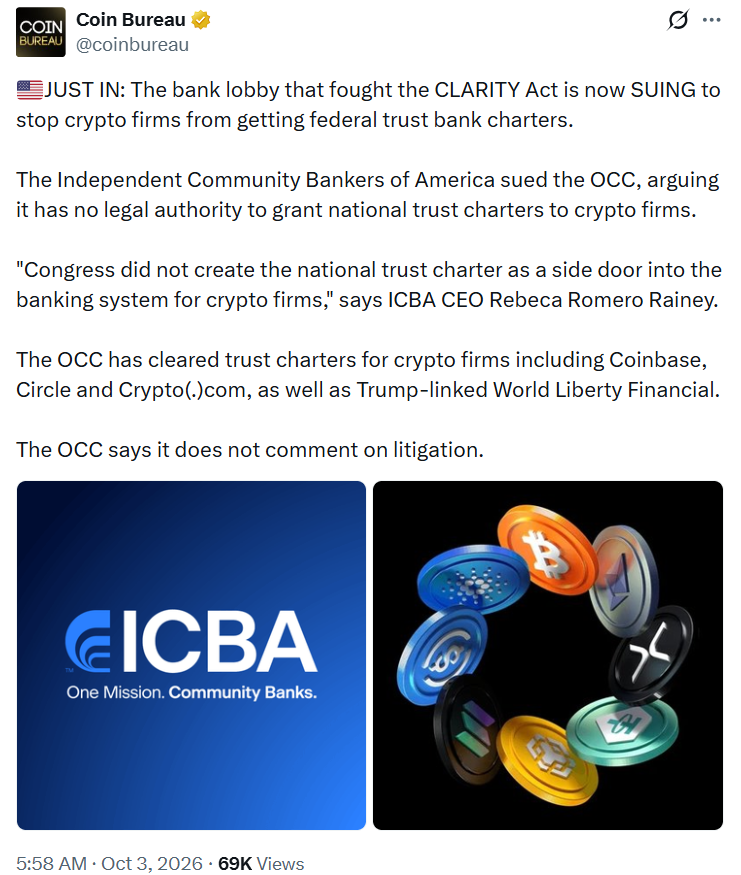
The Independent Community Bankers of America (ICBA) filed a lawsuit against the Office of the Comptroller of the Currency (OCC) on October 2, arguing that the federal banking regulator exceeded its authority by granting national trust bank charters to digital-asset companies.
The case places Coinbase, Circle, Crypto.com, and other crypto businesses at the center of a broader dispute over national bank charters, regulatory safeguards, and the competitive position of community banks.
Why the OCC’s Trust Charter Model Is Being Challenged
ICBA’s lawsuit focuses on the legal framework the OCC has used to authorize national trust banks that do not operate as conventional insured banks.
The banking organization is asking a federal court to invalidate the OCC’s March 2026 chartering rule and Interpretive Letter 1176, issued in 2021. According to the complaint, the agency’s interpretation has enabled companies outside the traditional banking sector to obtain national trust charters without meeting requirements associated with full-service banks.
The dispute centers on Section 27(a) of the National Bank Act and the scope of the OCC’s authority over national trust institutions.
The OCC has maintained that its 2026 rule was intended to clarify existing chartering authority rather than create a new category of national bank. Its position is that national trust banks can conduct certain non-fiduciary activities connected to trust-company operations.
ICBA disputes that interpretation and says the agency has effectively created an alternative route into the federal banking system.
Crypto Companies Move Closer to Traditional Finance
The lawsuit arrives as major digital-asset companies expand their relationships with the regulated financial sector.
Coinbase, Circle, and other crypto businesses have pursued trust structures that can support services such as digital-asset custody without operating as conventional banks that take retail deposits and extend traditional loans.
That distinction is important to the legal case.
National trust banks generally do not accept deposits in the same way as insured commercial banks. They also do not necessarily perform the lending functions associated with traditional banking. Their business can instead center on custody, fiduciary services, and other permitted financial activities.
ICBA argues that the federal charter still carries significant advantages. In its view, companies can obtain the credibility associated with a national bank charter while avoiding regulatory obligations imposed on insured depository institutions.
The organization has also raised concerns over capital, liquidity, supervision, and consumer protections.
ICBA Points to 21 National Trust Banks
The complaint broadens the dispute beyond a handful of crypto companies.
ICBA identified 21 trust banks whose approvals it is challenging, including 13 with connections to the cryptocurrency sector. Protego is among the institutions specifically referenced in the legal action.
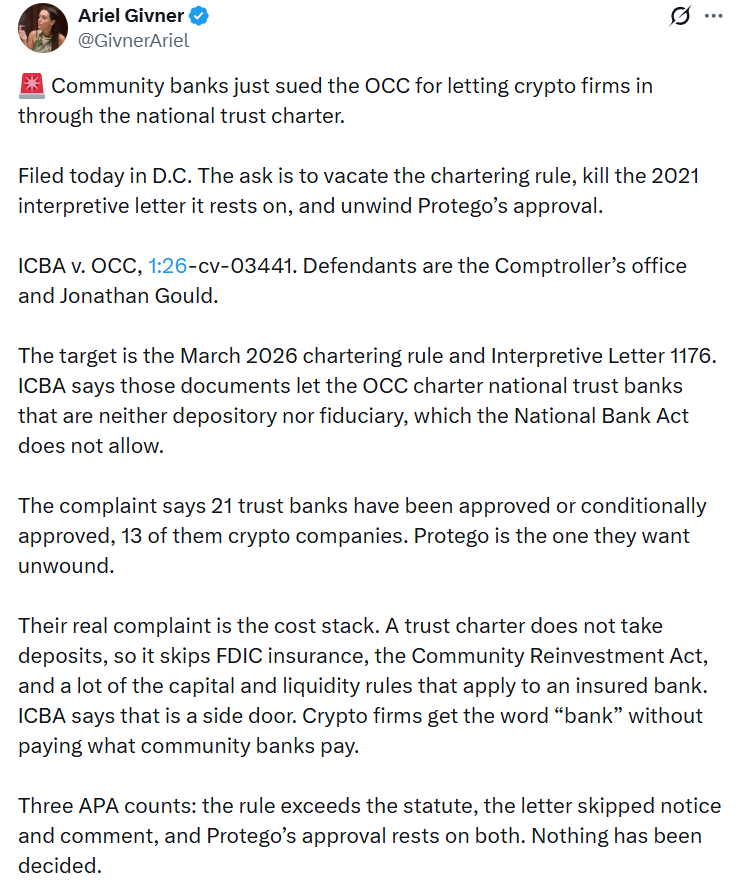
The banking group argues that the OCC’s approach could allow specialized institutions to operate under a federal banking framework without being subject to the full set of requirements faced by traditional insured banks.
Those differences include Federal Deposit Insurance Corporation coverage and obligations under the Community Reinvestment Act, as well as other prudential requirements applicable to deposit-taking institutions.
The case does not allege that the affected crypto firms committed fraud. Instead, it challenges the statutory and regulatory basis for the OCC’s chartering decisions.
Fintech attorney Ariel Givner has characterized the dispute as largely an industry and regulatory competition issue rather than a fraud case, noting that trust charters themselves restrict activities such as deposit-taking and conventional lending.
World Liberty Approval Raises the Stakes
The OCC’s recent charter decisions have added another dimension to the debate.
Among the institutions receiving approval is World Liberty Trust Company, associated with World Liberty Financial, the crypto venture linked to the Trump family.
The OCC granted conditional preliminary approval for the proposed national trust bank in 2026. Its proposed activities are tied to digital assets and stablecoin-related services rather than conventional retail banking.
The approval demonstrates how national trust charters are becoming increasingly relevant to companies building infrastructure around crypto custody, stablecoins, and digital payments.
For community banks, the question is whether these institutions should receive access to the federal chartering system under a framework that differs from the rules governing traditional banks.
SEC Crypto Custody Plans Add to Regulatory Shift
The OCC lawsuit comes amid a separate effort by the Securities and Exchange Commission to establish clearer rules for institutional cryptocurrency custody.
On October 1, the SEC proposed changes that would provide investment advisers and regulated funds with additional options for holding digital assets. The proposal includes conditions under which advisers could use self-custody arrangements and state-chartered trust companies as crypto custodians.
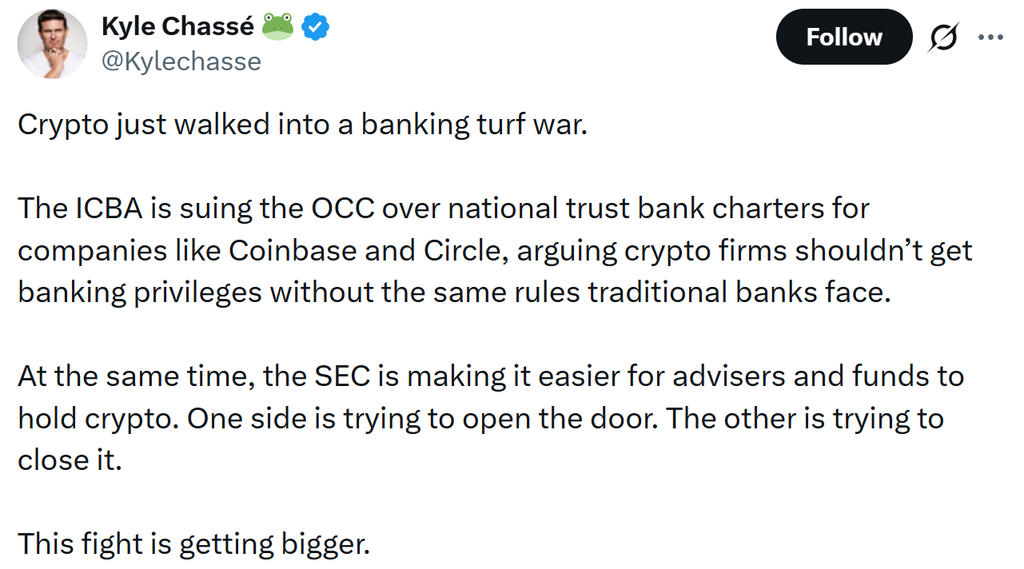
The developments show how different U.S. financial regulators are addressing the growing role of digital assets.
The SEC is focused on establishing a framework for investment firms and funds holding crypto assets. The ICBA lawsuit, meanwhile, questions whether the OCC has gone too far in allowing digital-asset businesses to obtain national trust bank charters.
Both developments point to a financial system where cryptocurrency is increasingly being integrated into regulated markets, but where the boundaries between banking, securities, and digital-asset services remain contested.
Court Fight Could Shape Future Crypto Charters
The outcome of ICBA v. OCC could have consequences well beyond the companies named in the complaint.
A ruling against the OCC could force the regulator to reconsider how it interprets its authority to charter national trust banks and potentially affect future applications from crypto exchanges, stablecoin companies, and digital-asset custodians.
A decision favoring the OCC would provide greater legal certainty for its current approach and could reinforce the use of national trust charters as a regulatory structure for specialized financial businesses.
For now, the central question is whether the OCC has simply applied an existing form of national bank charter to a new generation of financial companies or created a pathway that Congress never intended for crypto firms.
That question will now be tested in federal court as the U.S. financial system continues to adapt to the expanding role of digital assets.

Julia Thornton is a cryptocurrency reporter covering blockchain, digital assets, and financial technology. She reports on market developments, regulation, exchange activity, and industry trends, delivering timely and accurate coverage of the global crypto ecosystem.
View all stories by Julia Thornton →