 BTC
 ETH
 USDT
 BNB
 XRP
 USDC
 SOL
 TRX
 FIGR_HELOC
 ZEC
 HYPE
 DOGE
 XMR
 USDS

Peter Schiff Predicts New Bitcoin Lows as Michael Saylor Adds 250 BTC to Strategy’s Holdings
Peter Schiff expects Bitcoin to revisit lower price levels despite acknowledging that the cryptocurrency has held its recent gains better than gold.


Meanwhile, Michael Saylor’s Strategy acquired another 250 BTC for approximately $21.5 million, increasing its reported Bitcoin treasury to 848,250 BTC as of October 11, 2026.
The contrasting developments come as BTC’s longer-term moving averages indicate a generally constructive trend, while momentum indicators remain mixed. Traders are monitoring key price levels as they assess whether the recovery can continue amid uncertainty over interest rates and broader market conditions.
Peter Schiff Maintains Bearish Bitcoin Forecast Despite Price Resilience
Gold advocate Peter Schiff has reiterated his expectation that BTC will establish new lows, although its recent performance has surprised him. In remarks shared by Scott Melker, Schiff compared Bitcoin’s resilience with gold’s retreat following renewed Federal Reserve signals about interest rates and inflation.
“Bitcoin hasn’t given up those gains, which has surprised me a bit,” Schiff said, adding that he had expected the cryptocurrency to decline sooner.
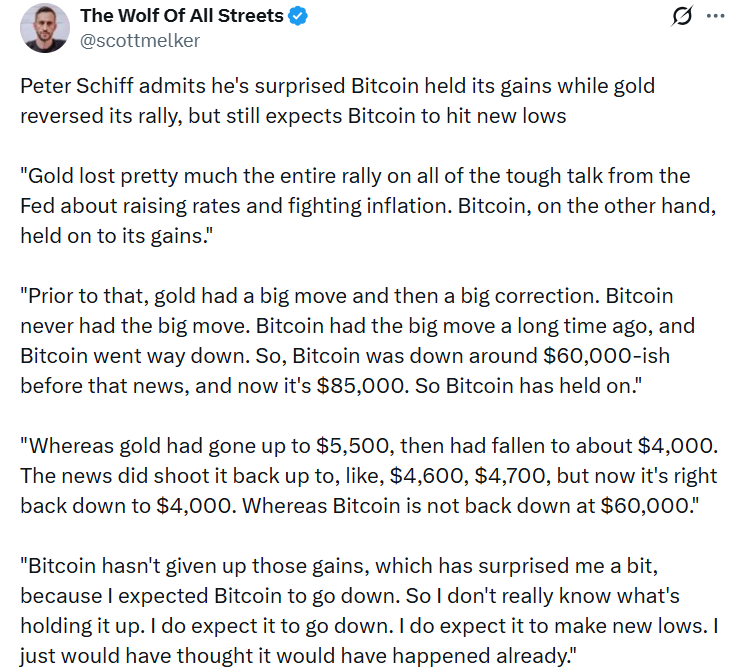
Schiff noted that BTC had recovered from approximately $60,000 to around $85,000 without returning to its previous low. Gold followed a different path, climbing to roughly $5,500 before falling toward $4,000. A subsequent recovery to approximately $4,600–$4,700 also faded.
“Gold lost pretty much the entire rally on all of the tough talk from the Fed about raising rates and fighting inflation. Bitcoin, on the other hand, held on to its gains,” Schiff said.
The comparison highlights different price responses to changing economic expectations. Gold is traditionally viewed as a store of value, while Bitcoin trades in a more volatile market influenced by liquidity, investor positioning, regulatory developments, and demand for digital assets.
Despite acknowledging BTC’s resilience, Schiff maintained his bearish outlook. “I do expect it to go down. I do expect it to make new lows,” he said. His forecast remains an opinion rather than a confirmed market outcome.
Strategy’s Bitcoin Treasury Reaches 848,250 BTC Under Michael Saylor
Michael Saylor’s Strategy continues to expand its Bitcoin reserves despite uncertainty over the cryptocurrency’s short-term direction. Its latest purchase of 250 BTC, valued at approximately $21.5 million, brought reported holdings to 848,250 BTC.
The position represents roughly 4% of Bitcoin’s maximum supply of 21 million coins. Strategy’s reported average acquisition cost stands at approximately $75,444 per BTC. At a market price near $86,000, its holdings would be valued above their aggregate purchase cost, although those unrealized gains fluctuate with the market.

Strategy also repurchased approximately $192 million in STRC preferred shares. The transactions reflect its broader capital-management approach, which combines Bitcoin accumulation with equity issuance and preferred securities. The company uses financing mechanisms, including at-the-market equity offerings, to support its treasury strategy.
MSTR common shares and STRC preferred shares provide different forms of exposure to the company’s financial performance and carry distinct risks. Bitcoin volatility, financing costs, potential shareholder dilution, and preferred-share obligations remain important considerations.
The latest purchase demonstrates Strategy’s continued commitment to Bitcoin, but its accumulation alone does not establish the direction of the wider cryptocurrency market.
Bitcoin Technical Analysis Shows Support From Longer-Term Moving Averages
TradingView’s technical summary assigned BTC a Buy rating, with 13 buy signals, eight neutral readings, and five sell signals. Moving averages provided the strongest support for this assessment, while oscillators indicated less decisive momentum.
Bitcoin’s Relative Strength Index (RSI) stood at 53, a neutral reading that suggested neither extreme buying nor selling pressure. The Commodity Channel Index and Momentum indicator generated buy signals, while the Average Directional Index and MACD offered more cautious readings.
The longer-term moving averages presented a more constructive picture. Bitcoin traded above its 50-day exponential moving average near $80,215, its 100-day EMA around $76,471, and its 200-day EMA near $75,572. The 200-day simple moving average stood at approximately $72,130.
Trading above these averages can indicate an established upward trend, although it does not rule out a correction. The 10-day and 20-day simple moving averages both registered sell signals, suggesting that short-term price action remained weaker than the broader trend.
BTC Price Outlook: $82,000 Support and $86,700 Resistance in Focus
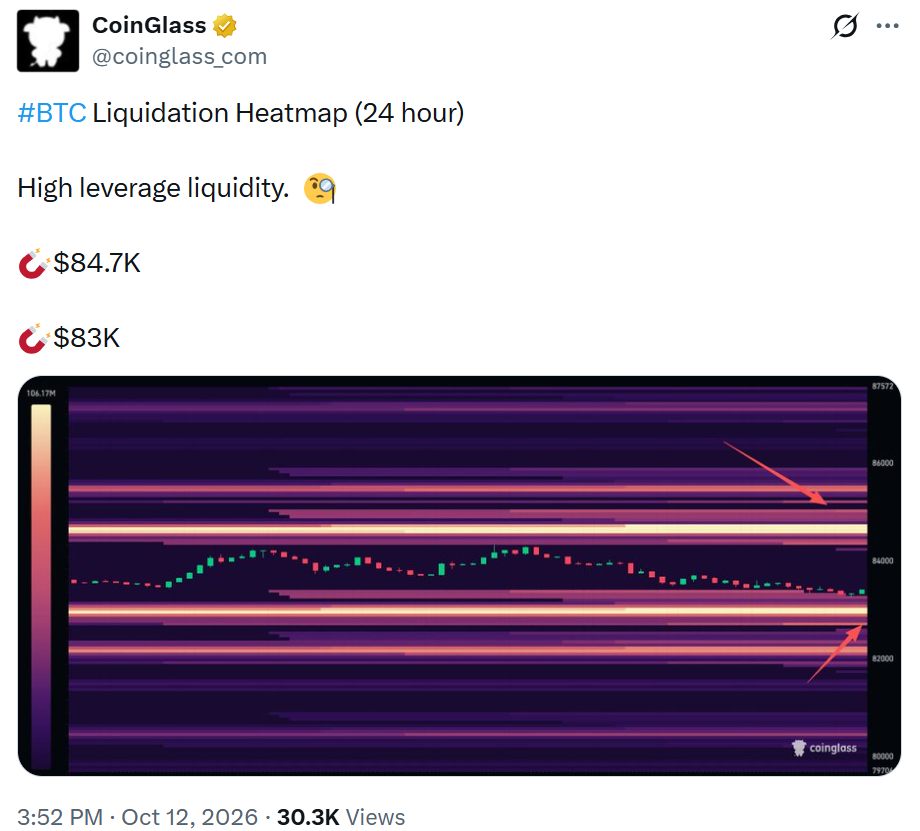
Bitcoin faces resistance between approximately $84,700 and $86,700, based on the supplied TradingView pivot calculations. A sustained move above this range could bring $88,986 and $94,410 into focus under the Classic pivot method.

On the downside, the $81,800–$82,300 region represents a key support area. A sustained break below it could expose BTC to the $76,500–$79,000 range. These levels are technical reference points, not guaranteed price targets.
The supplied market data lists Bitcoin at $83,347 on Bitstamp, up $1,602, or approximately 1.96%. This quote differs from the approximately $85,000 level cited in Schiff’s comments and the $86,000 reference used to assess Strategy’s holdings. The figures represent different market references and should not be treated as simultaneous prices.
Federal Reserve Policy Remains a Key Macro Factor for Bitcoin
Federal Reserve interest-rate expectations can influence borrowing costs, liquidity, and investor demand for risk-sensitive assets. Higher rates may increase the appeal of interest-bearing investments, while expectations of easier financial conditions can change demand for Bitcoin and other speculative assets.
Schiff’s broader comments also addressed U.S. debt, housing risks, economic data reliability, and artificial intelligence’s potential economic effects. These issues can shape investor sentiment, although their influence on cryptocurrency prices depends on wider market conditions.
For Bitcoin, the immediate technical test is whether buyers can defend support near $82,000 and push the price above $86,700. A breakout could open the way toward higher resistance, while a sustained breakdown would increase the risk of a deeper correction. Schiff’s prediction of new lows remains unconfirmed, while Strategy’s latest purchase reflects its ongoing treasury policy rather than a guarantee of future price gains.

Julia Thornton is a cryptocurrency reporter covering blockchain, digital assets, and financial technology. She reports on market developments, regulation, exchange activity, and industry trends, delivering timely and accurate coverage of the global crypto ecosystem.
View all stories by Julia Thornton →