 BTC
BTC  ETH
ETH  USDT
USDT  BNB
BNB  XRP
XRP  USDC
USDC  SOL
SOL  TRX
TRX  ZEC
ZEC  FIGR_HELOC
  HYPE
HYPE  DOGE
DOGE  XMR
XMR  WBT
WBT 
SEC Opens Onchain Stock Trading Path as Crypto Waits for CLARITY Act
The U.S. Securities and Exchange Commission has created a new regulatory pathway for tokenized stocks, giving blockchain-based financial markets a defined route into parts of the U.S. securities system even as Congress continues to debate broader crypto legislation.

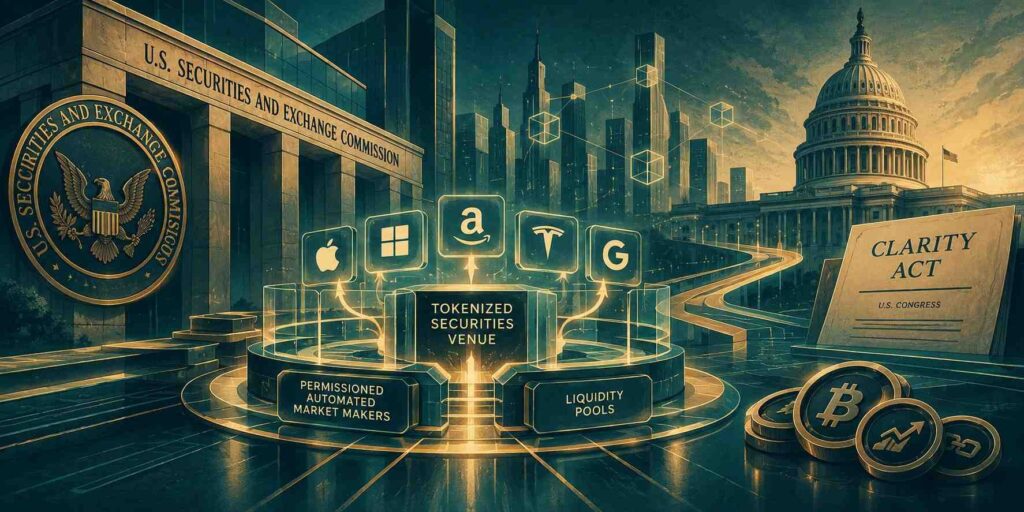
The SEC’s five-year Innovation Exemption allows qualifying crypto Securities Venues to facilitate secondary-market trading of certain tokenized National Market System stocks through permissioned automated market makers and liquidity pools. The framework comes as the CLARITY Act remains stalled in the Senate.
A New Route for Tokenized Securities
The SEC’s September 17 order is narrowly targeted at tokenized securities rather than the wider crypto market. Qualifying venues can receive relief from the Exchange Act’s traditional definition of an “exchange,” provided they comply with a series of conditions established by the agency.

The SEC granted temporary, conditional relief allowing tokenized securities venues to trade tokenized NMS stocks through permissioned automated market makers and liquidity pools. Source: SEC/X
SEC Chairman Paul Atkins said the initiative is intended to help “bring America’s capital markets into the digital age,” positioning tokenization as part of the broader modernization of financial-market infrastructure.
The exemption lasts for five years and is subject to public comment. The SEC can use feedback from crypto market participants to consider potential modifications as tokenized securities develop.
The framework also extends conditional relief to certain liquidity providers participating in automated market-maker pools, reducing the risk that qualifying participants would automatically fall within the Exchange Act’s dealer-registration requirements.
What the SEC Rules Actually Permit in Crypto Markets
The Innovation Exemption does not allow crypto platforms to freely list any U.S. stock as a blockchain token.
Instead, Tokenized Securities Venues must satisfy specific requirements before qualifying for the relief. Among them, tokenized NMS stocks must provide investors with rights and privileges equivalent to those attached to the corresponding traditional securities.

That means a token designed only to mirror the price of a stock without representing the underlying security does not qualify under the framework.
The SEC has also established an issuer notification process. Companies whose shares are being tokenized by unaffiliated parties must have an opportunity to object before those tokenized securities can be made available through a qualifying venue.
These provisions keep the crypto asset connected to the underlying security rather than treating it as a separate synthetic product.
Blockchain Moves Closer to Traditional Markets
The significance for the crypto sector extends beyond tokenized stocks themselves.
Blockchain networks can potentially automate parts of trading, settlement, and ownership records through smart contracts. Tokenized securities therefore create a potential bridge between conventional financial assets and infrastructure originally developed for digital assets.

SEC Commissioner Mark Uyeda has pointed to possible applications across issuance, trading, transfers, settlement, and ownership records. The agency has also highlighted potential benefits involving transparency, liquidity, and transaction costs.
For crypto companies, that creates another potential market for trading platforms, custody providers, and other blockchain infrastructure businesses.
Several large financial and crypto platforms have already explored tokenized equities in different markets. The SEC’s exemption could provide a more clearly defined U.S. regulatory framework for similar products, although eligibility remains subject to the agency’s conditions.
Strict Controls in Crypto Remain in Place
The new framework should not be interpreted as unrestricted approval for onchain U.S. stock trading.
The SEC has placed limits on eligible securities and trading volumes. Qualifying venues must also maintain public, auditable smart contracts and provide transparency around relevant operations.
Trading must remain synchronized with conventional markets in important circumstances. If the underlying NMS stock is halted on its primary exchange, trading in the corresponding tokenized security must also stop on the qualifying venue.
The rules also contain requirements covering U.S. persons, sanctions compliance, and transaction transparency.
These safeguards reflect the SEC’s attempt to permit experimentation with blockchain-based market infrastructure without removing the crypto investor protections attached to conventional securities markets.
CLARITY Act Remains a Separate Question
The Innovation Exemption arrives shortly after the Senate failed to advance the CLARITY Act.
The legislation was designed to address a much broader section of the digital-asset market, including the regulatory structure surrounding crypto assets and the responsibilities of different federal agencies.
The SEC’s action therefore does not resolve the broader questions that remain before Congress.
Instead, the agency has used its existing statutory authority to address one specific area: the secondary trading of certain tokenized securities.
That distinction matters for the crypto industry. A regulatory framework for tokenized stocks does not establish comprehensive rules for cryptocurrencies, exchanges or every other type of digital asset.
Five Years to Test the Model
The SEC’s five-year window gives market participants time to develop and test tokenized securities infrastructure within defined regulatory boundaries.
The experiment will provide data on investor demand, liquidity, trading volumes and the operational challenges associated with linking blockchain markets to traditional exchanges.
It could also reveal whether tokenized securities become a significant component of U.S. market infrastructure or remain a specialized product.
Much will depend on whether issuers, trading venues and investors participate under the SEC’s conditions.
For crypto companies, however, the immediate change is regulatory rather than purely commercial. A specific pathway now exists for qualifying platforms seeking to bring certain U.S. equities onto blockchain-based markets.
The Bigger Picture for Crypto
The SEC’s decision adds another layer to the evolving relationship between crypto infrastructure and traditional finance.
While the CLARITY Act remains unresolved, the Innovation Exemption provides a narrower mechanism for testing blockchain-based securities markets under federal oversight.
The two developments should therefore be viewed separately. Congressional legislation could eventually establish broader rules for digital assets, while the SEC’s exemption focuses on a specific application of blockchain technology within the securities market.
For now, tokenized equities have moved from a largely experimental concept toward a more clearly defined regulatory test in the United States. The results of that five-year experiment could influence how regulators and financial institutions approach the next stage of onchain markets.

Julia Thornton is a cryptocurrency reporter covering blockchain, digital assets, and financial technology. She reports on market developments, regulation, exchange activity, and industry trends, delivering timely and accurate coverage of the global crypto ecosystem.
View all stories by Julia Thornton →