 BTC
BTC  ETH
ETH  USDT
USDT  BNB
BNB  XRP
XRP  USDC
USDC  SOL
SOL  TRX
TRX  ZEC
ZEC  FIGR_HELOC
  HYPE
HYPE  DOGE
DOGE  XMR
XMR  WBT
WBT 
XRP News Today: Ripple CEO Brad Garlinghouse Predicts $10 Trillion XRP Market Cap
A long-term valuation scenario tied to Ripple CEO Brad Garlinghouse has reignited debate over how large XRP could become if blockchain-based payments gain a much larger role in global finance.

The figure circulating across social media places XRP at a potential $10 trillion market capitalization within 10-15 years. Based on the supply assumption used in the calculation, that would translate to approximately $179.50 per token. The projection, however, should not be treated as a formal Ripple-issued price target without a direct source confirming that interpretation.
A $10 Trillion Scenario for XRP
The reported valuation is built around a simple market-cap calculation. If XRP were valued at $10 trillion and the relevant circulating supply remained close to the level used in the estimate, the resulting XRP price would be around $179.50.

That would put the price far above its present valuation and require the cryptocurrency to capture a meaningful share of global financial activity. Such an outcome would depend on much more than speculative demand.
The case being discussed by XRP supporters centers on several long-term developments. These include clearer cryptocurrency regulation, greater institutional participation, and increased use of blockchain networks for international payments.
Garlinghouse has frequently argued that moving value should become as efficient as moving information. That broader thesis is relevant to the token’s investment case, although it does not by itself establish a specific future XRP price.
Why Cross-Border Payments Matter
The payment market is central to Ripple’s long-running XRP strategy. The company has promoted blockchain infrastructure as an alternative to parts of the correspondent-banking system, particularly where international transactions can require multiple intermediaries and pre-funded liquidity.
The token’s proposed role is different from simply being a speculative cryptocurrency. Ripple has positioned the token as a bridge asset that can help facilitate the movement of value between currencies and jurisdictions.
If such applications expanded substantially, transaction demand and liquidity could become important factors in the long-term Ripple XRP price. The scale of that potential adoption remains uncertain, however, and blockchain payment growth does not automatically translate into an equivalent increase in the token’s market capitalization.
That distinction is particularly important when assessing an XRP price prediction extending a decade or more into the future.
Garlinghouse Points to Gold as a Financial Contrast
Garlinghouse recently used the movement of central-bank gold reserves to illustrate what he considers the limitations of conventional financial infrastructure.
De Nederlandsche Bank announced that it had relocated about 86 tonnes of gold from New York and Ottawa to London during 2026. The central bank said the move was intended to improve the tradability and availability of its reserves while strengthening its ability to respond to potential crises.
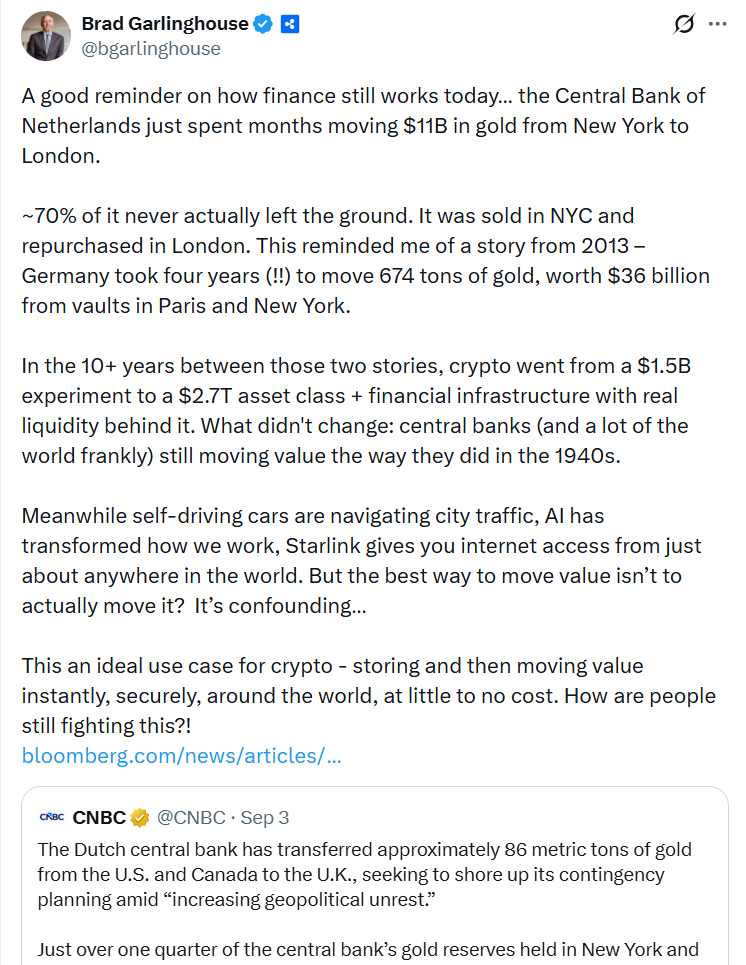
The operation involved both physical transportation and transactions in which gold was sold in one location and repurchased in another. Garlinghouse cited the process as an example of how difficult it can be to move large amounts of value through established financial systems.
His comparison extends beyond gold. He has argued that technological advances have transformed areas such as artificial intelligence and autonomous driving while the movement of money remains comparatively constrained by legacy infrastructure.
That argument forms part of the broader rationale behind his support for blockchain-based settlement.
XRPL Gets a Real-World Test From the BIS
One of the more significant developments surrounding the XRP Ledger is separate from the $10 trillion valuation discussion.
The Bank for International Settlements has examined the XRP Ledger in a proof-of-concept project involving official statistics. The research explored whether cryptographic fingerprints of statistical datasets could be anchored to a blockchain so users could later verify that information had not been altered.
The BIS reported rapid performance in its controlled testing, with median publication latency of three to five seconds and verification latency of one to two seconds. The study also found that transaction fees were negligible when data was processed in relatively modest batches.
The experiment does not mean the BIS has endorsed the token as a global settlement currency. It also does not provide evidence for a particular XRP price forecast 2026.
Its significance is narrower but more measurable: an international financial institution tested XRPL technology for a specific verification use case and documented its technical performance.
XRP’s Market Potential Goes Beyond One Forecast
The $10 trillion scenario has also appeared alongside promotion for REAL TOKEN, a project describing itself as a three-layer decentralized network built on the XRP Ledger.
The project claims exposure to a combined $38.5 trillion global market opportunity across media and payment-related activities. Those figures represent the project’s stated addressable-market thesis and should not be confused with the current value of XRPL.
This distinction is important because large addressable-market figures are often used in promotional material. An industry’s total potential economic activity does not mean that a blockchain network or cryptocurrency will capture that entire market.
For XRP, the more relevant question is whether sustained network adoption creates measurable demand for the token itself.
Long-Term Chart Structure Adds Another Variable
Fundamental developments are only one side of the token’s outlook. Long-term technical analysis is also attracting attention as traders examine whether the current market cycle will repeat patterns seen during previous periods.
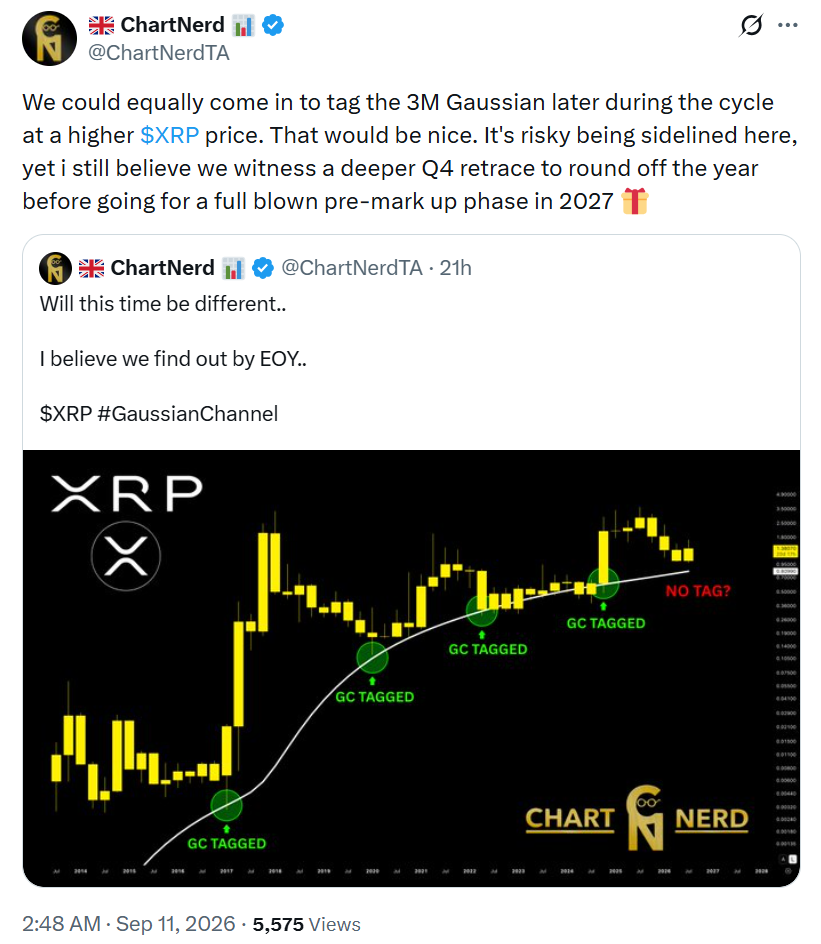
Analyst ChartNerdTA has highlighted XRP’s position relative to a long-term Gaussian Channel. The analysis compares current price behavior with earlier points in the token’s history where the asset interacted with the lower portion of the channel before entering larger market moves.
The analyst’s interpretation leaves room for several outcomes. The price could eventually return to the three-month Gaussian Channel at a substantially higher level, while another possibility involves a deeper correction during the fourth quarter of 2026 before a stronger advance develops in 2027.
This analysis should be viewed as a technical scenario rather than a guaranteed XRP price prediction. Indicators based on historical market behavior can identify recurring structures, but they cannot determine whether future cycles will reproduce previous patterns.
What Would Need to Change for $179.50 XRP?
A token price near $179.50 would require a dramatic expansion in XRP’s market capitalization.
The mathematics behind the target is relatively straightforward. The greater challenge is determining whether enough capital, liquidity, and fundamental demand could develop to support a $10 trillion valuation.

Several conditions would likely matter. Greater use of blockchain settlement by financial institutions could increase demand for digital-asset liquidity. Regulatory clarity could reduce barriers for institutional participation. Wider adoption of tokenized assets and international blockchain payments could also expand the addressable market.
None of these developments guarantees that XRP would capture the resulting activity. Competition among blockchain networks, changes in payment technology, regulation, and shifts in investor demand would all influence the eventual outcome.
For that reason, a price target based on a distant market-cap scenario should be separated from near-term market analysis.
XRP’s Next Phase Depends on Adoption and Liquidity
The current XRP narrative combines a highly ambitious long-term valuation with more concrete developments in blockchain infrastructure.
Garlinghouse’s comments about inefficient value transfer highlight the problem Ripple has sought to address through digital-payment technology. The BIS’s XRPL proof of concept offers independent evidence that the ledger can support a specific institutional blockchain application. Meanwhile, the long-term Gaussian Channel analysis provides a technical framework for traders watching the token’s next major cycle.
Together, these developments help explain why the price remains a focus of the cryptocurrency market. They do not, however, establish that XRP will reach $179.50.
The reported $10 trillion scenario is therefore best understood as a long-range possibility rather than a confirmed forecast. For anyone tracking XRP news today, the more important indicators will be actual payment adoption, institutional usage, regulatory developments, liquidity conditions, and XRP’s evolving market structure.
Those factors will ultimately determine whether today’s ambitious price projections develop into measurable changes in the asset’s value.

Julia Thornton is a cryptocurrency reporter covering blockchain, digital assets, and financial technology. She reports on market developments, regulation, exchange activity, and industry trends, delivering timely and accurate coverage of the global crypto ecosystem.
View all stories by Julia Thornton →