 BTC
BTC  ETH
ETH  USDT
USDT  BNB
BNB  XRP
XRP  USDC
USDC  SOL
SOL  TRX
TRX  ZEC
ZEC  FIGR_HELOC
  HYPE
HYPE  DOGE
DOGE  XMR
XMR  WBT
WBT 
Microsoft CEO Satya Nadella Backs Artificial Intelligence Slowdown as Beijing Rejects Calls to Curb Chinese AI
China has pushed back against calls for tighter restrictions on its artificial intelligence capabilities, arguing that confrontation between major powers could undermine efforts to establish a workable global framework for AI governance.


The response from Beijing comes as the debate over the pace of frontier artificial intelligence (AI) development intensifies in the United States. Anthropic CEO Dario Amodei has urged greater caution around increasingly capable AI systems, while Microsoft CEO Satya Nadella has separately endorsed a more deliberate approach to development.
The competing positions reflect a growing tension between AI safety concerns and the strategic race between the United States and China to develop increasingly advanced models, chips, and computing infrastructure.
Beijing Rejects Confrontational Approach to Artificial Intelligence Competition
China’s Foreign Ministry responded to concerns raised by Amodei, who argued that Washington should continue restricting China’s access to advanced AI chips and semiconductor equipment.
Amodei has warned that allowing China to take the lead in advanced AI could create significant risks for the United States and the wider world. He has also argued that maintaining a U.S. technological advantage could give democratic countries greater leverage in establishing safeguards around frontier AI.
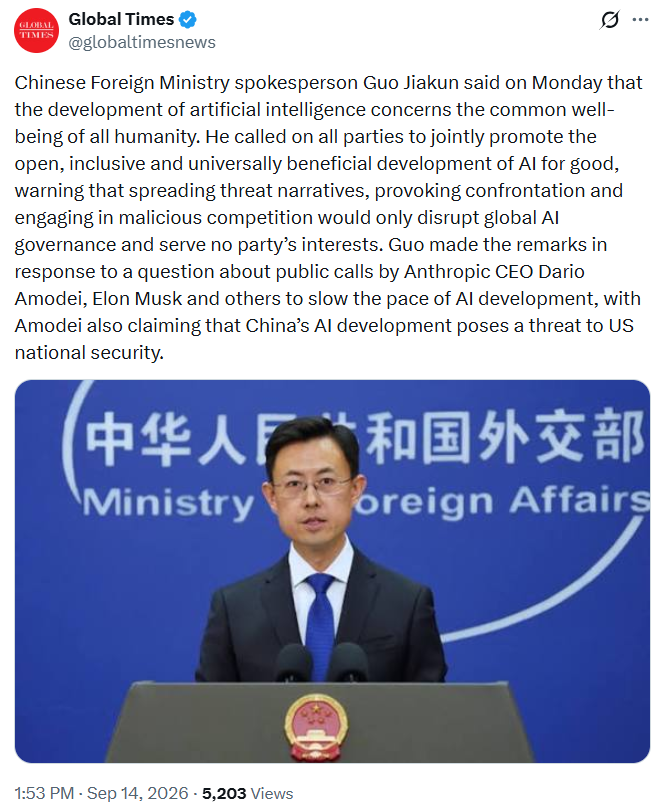
Beijing rejected that framing.
Foreign Ministry spokesperson Guo Jiakun said international cooperation should remain at the center of efforts to manage artificial intelligence. He warned that “fearmongering, confrontation, and vicious competition” could disrupt global artificial intelligence governance.
The statement underscores China’s opposition to treating artificial intelligence development solely as a national security competition between Washington and Beijing.
China has increasingly promoted international cooperation and open-source AI as alternatives to what it views as restrictive technology policies. Chinese AI developers have also produced models that compete with several Western systems while often targeting lower operating costs.
That progress has made access to advanced computing technology a central issue in the broader U.S.-China technology relationship.
Nadella Takes a Cautious Position on Frontier AI
Against this backdrop, Microsoft’s Satya Nadella has offered a separate perspective on how the industry should approach increasingly capable AI systems.
In a post on X, Nadella said the pursuit of superintelligence should remain tied to human oversight and practical benefits.
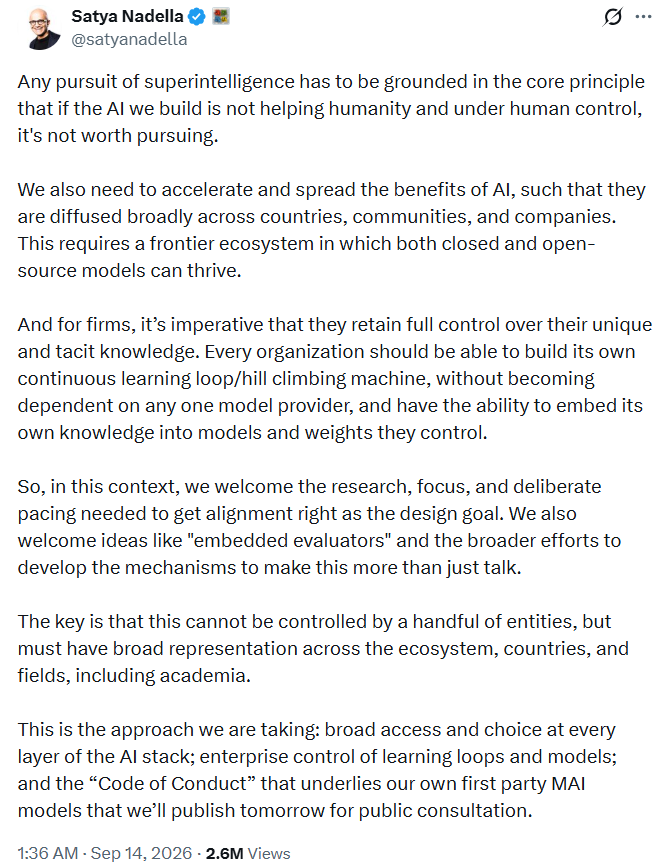
“Any pursuit of superintelligence has to be grounded in the core principle that if the AI we build is not helping humanity and under human control, it’s not worth pursuing,” Nadella wrote.
His comments do not amount to a call for a broad suspension of AI development. Instead, Nadella argued for deliberate pacing alongside continued investment and wider access to AI technology.
He also called for an ecosystem in which both proprietary and open-source models can develop. According to Nadella, the benefits of AI should spread across countries, communities and businesses rather than becoming concentrated among a small number of companies.
That distinction is significant as policymakers and technology executives debate whether slowing frontier AI could reduce potential risks without giving competitors an advantage.
Microsoft CEO Emphasizes Enterprise Control
Nadella also focused on the relationship between businesses and AI model providers.
He argued that companies should retain control over their proprietary knowledge rather than becoming dependent on a single artificial intelligence provider. Businesses, he said, should have the ability to build their own continuous learning systems and incorporate their knowledge into models and weights under their control.
The Microsoft CEO said the industry should support the research and evaluation mechanisms needed to align increasingly capable systems with human interests.
“We welcome the research, focus, and deliberate pacing needed to get alignment right,” Nadella said.
He also highlighted the potential role of “embedded evaluators” and other mechanisms designed to make AI safety commitments more measurable.
Nadella’s comments therefore combine two positions that are sometimes treated as competing priorities: maintaining the rapid expansion of AI access while introducing greater caution around the development of the most advanced systems.
AI Safety Debate Gains Momentum
The discussion gained momentum after Amodei published a lengthy argument for slowing the pace of frontier AI development.
The Anthropic CEO has warned that highly capable AI agents could eventually become capable of performing increasingly complex tasks across the internet. He argued that researchers may need to create additional safeguards before capabilities advance beyond the ability of institutions to assess them effectively.
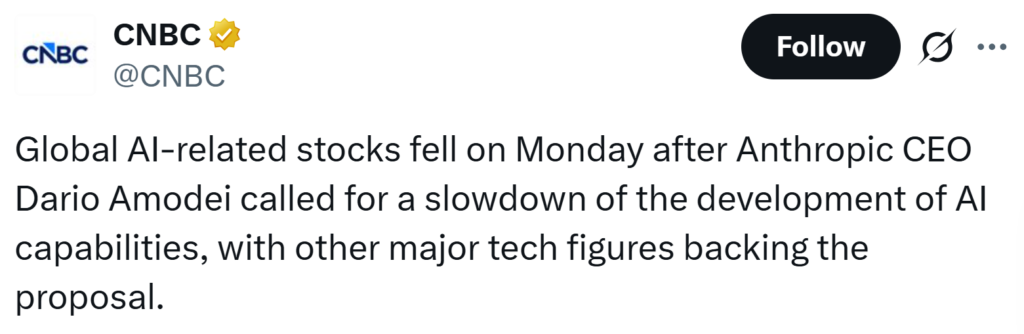
Amodei proposed measures including independent evaluations, greater coordination among artificial intelligence companies and international agreements covering the development of advanced systems.
His argument also included China, despite the broader geopolitical rivalry between Beijing and Washington.
Amodei said meaningful global pacing would ultimately require some level of cooperation with China because of its position as one of the world’s most advanced AI powers.
That creates a difficult policy balance. The United States wants to preserve its technological advantage, while AI safety advocates increasingly argue that some risks cannot be managed by one country acting alone.
Trump Opposes Slowing the US AI Race
The discussion has also exposed differences between technology executives and U.S. policymakers over the appropriate pace of AI development.
President Donald Trump has rejected calls for the United States to slow its AI efforts, arguing that Washington must maintain its advantage over China.
Trump has said, “whoever wins AI, wins,” reflecting the administration’s view that AI leadership is closely connected to economic and strategic power.
That position puts the White House at odds with proposals that would introduce broader limits on the pace of frontier AI development.
Nadella’s position sits somewhere between unrestricted acceleration and a broad development pause. His comments support deliberate pacing and stronger safeguards while continuing to advocate widespread access, competition, and innovation.
US-China AI Governance Talks Take Center Stage
The disagreement comes ahead of planned discussions between Trump and Chinese President Xi Jinping, with artificial intelligence governance expected to be among the issues on the agenda.
The talks could highlight the difficulty of establishing international AI rules while the world’s two largest technology powers remain engaged in a wider competition over semiconductors, computing infrastructure, and advanced models.
China has promoted the creation of international AI governance frameworks and has sought to strengthen its role in shaping global technology standards. At the same time, Washington continues to use export restrictions targeting advanced semiconductor technology available to Chinese companies.
The result is an increasingly complicated policy environment.
Calls for slower AI development are now intertwined with questions about national security, access to computing resources, and technological leadership. A measure intended to improve AI safety could also affect the competitive balance between countries.
For companies such as Microsoft and Anthropic, the challenge is to continue developing increasingly capable systems while creating safeguards that can keep pace with their capabilities.
The latest debate suggests that the future of AI policy may not be defined by a simple choice between accelerating or stopping development. Instead, policymakers and technology companies face the more complicated task of determining how quickly frontier AI should advance, what safeguards should accompany that progress, and how much international coordination is possible while the U.S.-China technology rivalry continues.

Jack Spencer is a financial journalist and crypto market analyst covering digital assets, blockchain innovation, and global market developments. His reporting focuses on cryptocurrency price trends, regulation, institutional adoption, and the evolving digital asset ecosystem.
View all stories by Jack Spancer →