 BTC
BTC  ETH
ETH  USDT
USDT  BNB
BNB  XRP
XRP  USDC
USDC  SOL
SOL  TRX
TRX  ZEC
ZEC  FIGR_HELOC
  HYPE
HYPE  DOGE
DOGE  XMR
XMR  WBT
WBT 
Bitcoin (BTC) Price Prediction: $79K Holds as BTC Eyes $83K Resistance Before a Possible $100K Test
Bitcoin is entering September with its recovery intact but facing a significant technical hurdle above $80,000.


BTC is trading near $79,000 after briefly climbing above $81,000 this week, keeping the $82,000-$84,000 region firmly in focus for traders.
The latest move follows a sharp rebound from the lows seen earlier in August. Bitcoin has now recovered much of that decline, but the market has yet to establish a sustained break above the resistance that separates the current range from higher levels.
A recent technical analysis identified $82,793 as an important resistance point, noting that a break above it could open a path toward $90,000 and potentially Bitcoin’s 2026 high near $97,867.
That leaves the $100,000 level within sight, but not yet confirmed by the price structure.
BTC Price Holds Above a Key Recovery Zone
Bitcoin’s latest advance has brought the asset back toward the upper portion of its recent trading range.
The cryptocurrency briefly reached about $81,400 after dovish comments from Federal Reserve Governor Christopher Waller helped lift risk assets. Bitcoin subsequently slipped back below $80,000 following stronger-than-expected U.S. employment data.
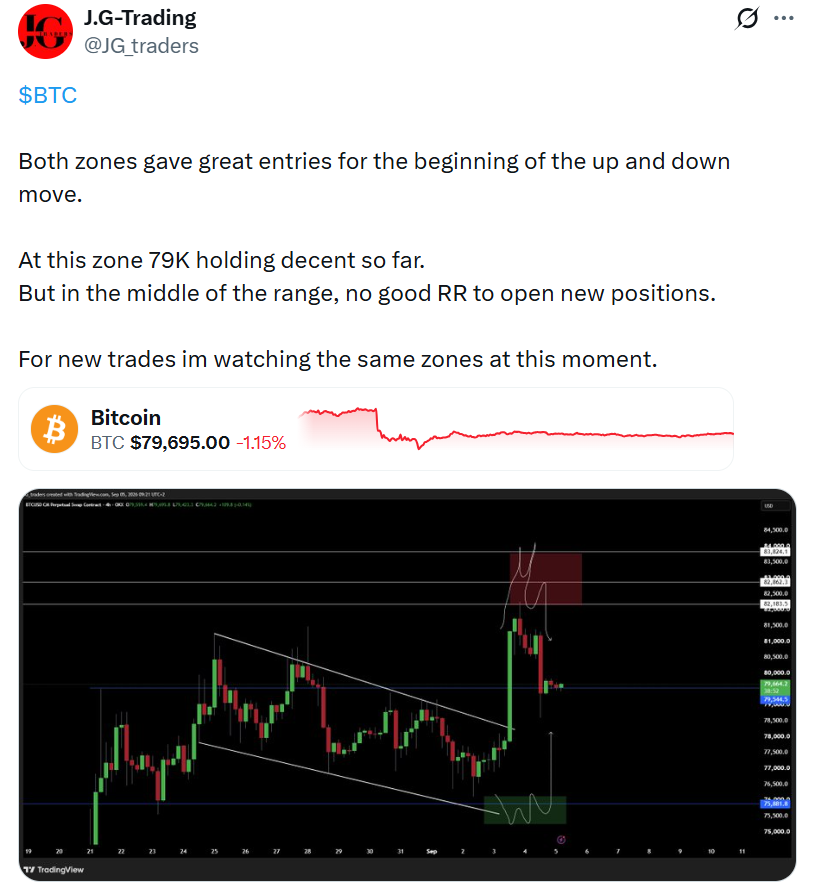
As of September 5, BTC remains around the $79,000-$80,000 area. Market data puts the latest price close to $79,600, although prices can vary slightly between exchanges.
This makes $79,000 an important short-term reference. Holding the area would preserve the recovery structure, while a deeper decline could bring lower support zones back into play.
$83K Resistance Is the Main Test for Bitcoin
The most important question for the current Bitcoin price prediction is whether buyers can absorb the supply positioned above $80,000.
TradingView analyst PremiumTrader57 identified the $82,000-$84,000 region as the immediate resistance zone. The analysis describes Bitcoin’s recent structure as a bullish flag following a break above a longer-term trendline.
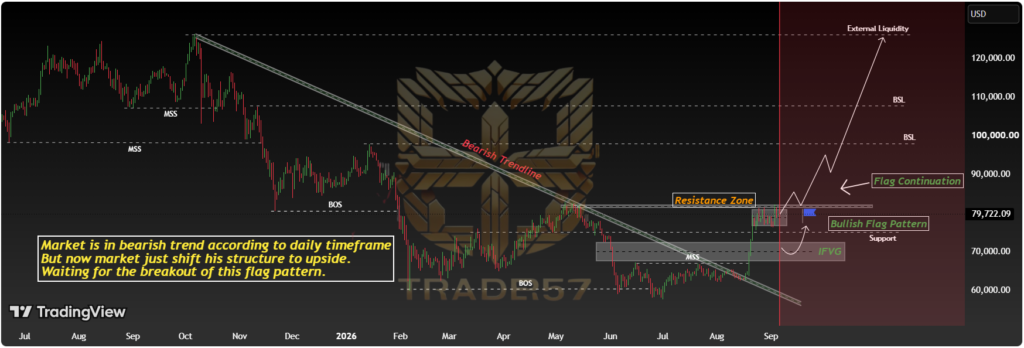
Under that technical scenario, a breakout followed by a successful retest of the $82,000-$84,000 area could strengthen the case for another advance.
The setup does not necessarily mean Bitcoin will move directly to $100,000. The market would still need to clear intermediate resistance levels and maintain momentum after the breakout.
Reuters’ latest technical assessment similarly places $82,793 at the center of the current setup. The level coincides with the May high and sits near the 61.8% Fibonacci retracement of Bitcoin’s broader decline.
A sustained move above that barrier would therefore carry more significance than a brief intraday spike.
Risk-On Signal Gives BTC Bulls Another Tailwind
Another factor supporting the current Bitcoin price forecast is a shift in Glassnode’s Bitcoin Vector framework.
The proprietary model moved into a risk-onGlassnode’s Bitcoin Vector Signal flipped to Risk-On on August 20, 2026, after marking the $126K all-time high as Risk-Off in October 2025. Source: Glassnode/X regime in August after previously entering Risk-Off territory near Bitcoin’s October 2025 cycle peak. Glassnode’s current Vector page describes the latest setup as an “Optimal risk-on environment.”
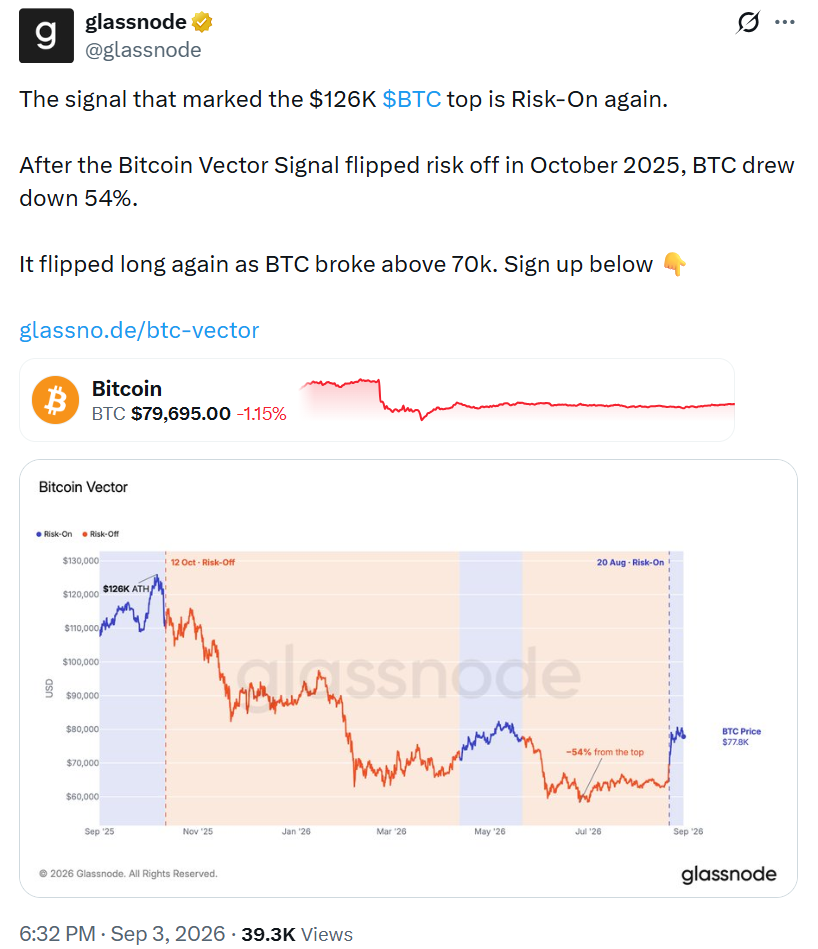
The change is notable because Bitcoin subsequently went through a major correction before recovering.
However, a Risk-On classification should not be interpreted as a guarantee of higher prices. It is a market-regime indicator rather than a fixed Bitcoin price prediction.
That distinction is particularly important while BTC remains below the $82,000-$86,000 supply area identified by recent market analysis.
The signal provides a more constructive backdrop, but price confirmation remains necessary.
Bitcoin Trading Volume Shows Renewed Activity
Bitcoin’s recovery has also been accompanied by a pickup in trading activity.
CryptoQuant data cited in the supplied analysis showed spot volumes during the latest move toward $80,000 running several times above earlier levels. Binance accounted for a substantial share of the activity.
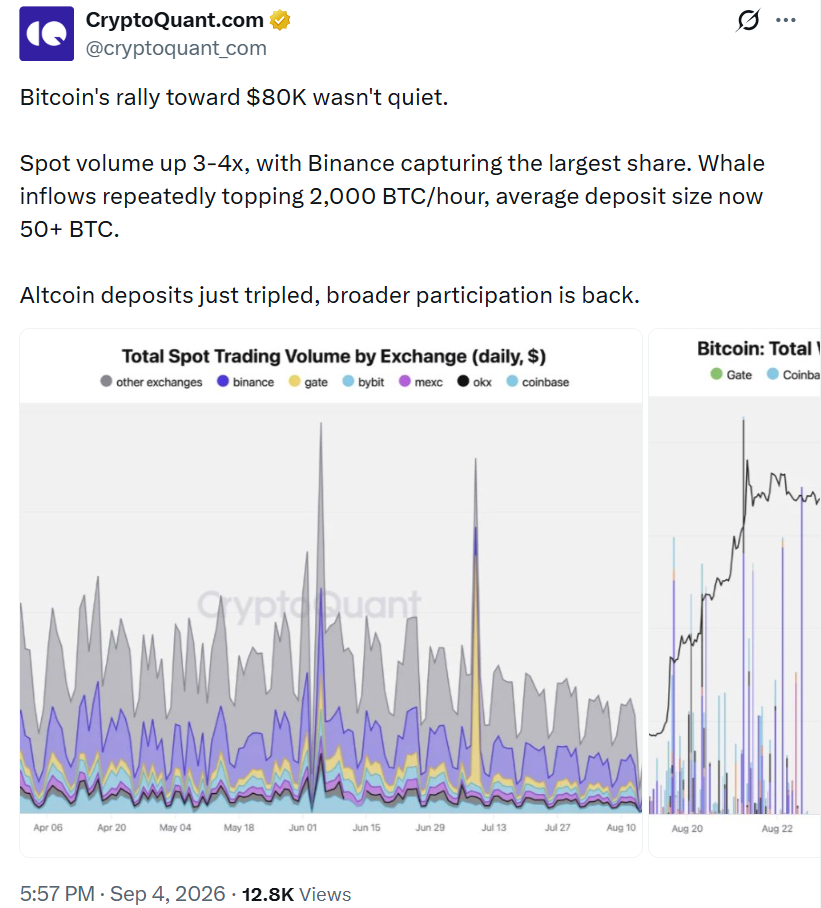
The same data showed repeated periods of whale exchange inflows above 2,000 BTC per hour, while average deposit sizes on Binance climbed above 50 BTC.
Large transfers can indicate heightened activity among major holders, but they do not automatically represent buying. BTC moving onto exchanges can increase available liquidity for either purchases or sales.
For that reason, exchange flows are most useful when considered alongside price, spot volume and broader market demand.
The increase in activity nevertheless suggests that the recent recovery has attracted considerably more participation than the quieter trading seen earlier in the year.
August Rally Defied Weak Crowd Sentiment
Bitcoin’s performance in August provides another interesting contrast.
BTC gained roughly 25% during the month, advancing from approximately $64,700 to around $78,300. According to the Santiment data, the rally occurred without a corresponding surge in crowd optimism.

Average sentiment reportedly remained near +32 during the advance, compared with approximately +72 during July.
An early-August security incident involving a Coldcard hardware wallet reportedly resulted in losses exceeding $100 million worth of Bitcoin and pushed sentiment sharply lower.
The lack of widespread euphoria during the subsequent recovery could be significant from a market-psychology perspective. Bitcoin rose while investors remained comparatively cautious rather than aggressively chasing the move.
That does not establish that another rally is coming. It does, however, distinguish the current recovery from periods when rapidly rising prices were accompanied by extreme speculative enthusiasm.
Macro Data Could Still Disrupt the Bitcoin Forecast
The broader economic backdrop remains a potential source of volatility.
Friday’s U.S. employment report showed nonfarm payrolls increasing by 162,000 in August, substantially above economists’ expectations. The unemployment rate remained at 4.1%. The stronger data pushed Treasury yields higher and increased market expectations for a possible Federal Reserve rate hike.
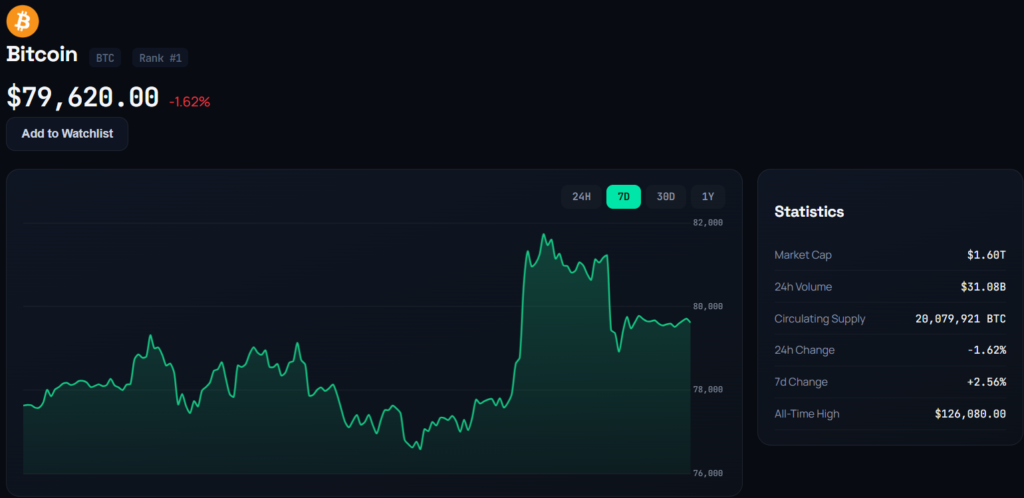
Bitcoin initially held up relatively well but later moved below $80,000.
The reaction illustrates why the latest Bitcoin price prediction cannot rely solely on technical indicators. Monetary-policy expectations remain an important influence on risk assets, including cryptocurrencies.
Investors are now looking toward upcoming U.S. inflation data for additional clues about the Federal Reserve’s next decision. The September policy meeting is scheduled for September 15-16, according to current market reporting.
If financial conditions become tighter, Bitcoin could face renewed pressure even if its chart structure remains constructive.
Bitcoin (BTC) Price Prediction: Is $100K Back in View?
Bitcoin’s path toward $100,000 is becoming technically relevant, but the market still has several hurdles to clear.
The first is $82,000-$84,000. A decisive move above that region would place the $90,000 area into focus, followed by the 2026 high near $97,867. Only after those levels are cleared would $100,000 become the next major psychological milestone.
The latest technical analysis supports this progression, identifying $82,793 as the key resistance and $90,000 as the next potential target after a confirmed breakout.
On the other hand, failure to hold the current recovery could send BTC back toward $75,674 and $71,781. A break beneath the latter would materially weaken the short-term bullish structure and could expose Bitcoin to substantially lower levels.
For now, the evidence points to a market recovering rather than one that has already confirmed a new leg toward $100,000. BTC’s ability to defend the $79,000 area while challenging the $82,000-$84,000 resistance zone will likely determine whether the current rebound develops into a broader advance.
The Risk-On signal, stronger trading activity, and August’s price recovery provide constructive evidence. Yet resistance, macroeconomic uncertainty, and the lack of a confirmed breakout mean the $100,000 target remains a conditional scenario rather than an established forecast.

Jack Spencer is a financial journalist and crypto market analyst covering digital assets, blockchain innovation, and global market developments. His reporting focuses on cryptocurrency price trends, regulation, institutional adoption, and the evolving digital asset ecosystem.
View all stories by Jack Spancer →