 BTC
BTC  ETH
ETH  USDT
USDT  BNB
BNB  XRP
XRP  USDC
USDC  SOL
SOL  TRX
TRX  ZEC
ZEC  FIGR_HELOC
  HYPE
HYPE  DOGE
DOGE  XMR
XMR  WBT
WBT 
AI Power Race Intensifies as Zuckerberg Challenges Regulation and Musk Demands More Data Centers
The race to expand artificial intelligence (AI) in the United States is increasingly becoming a race for electricity, computing infrastructure, and favorable regulation.

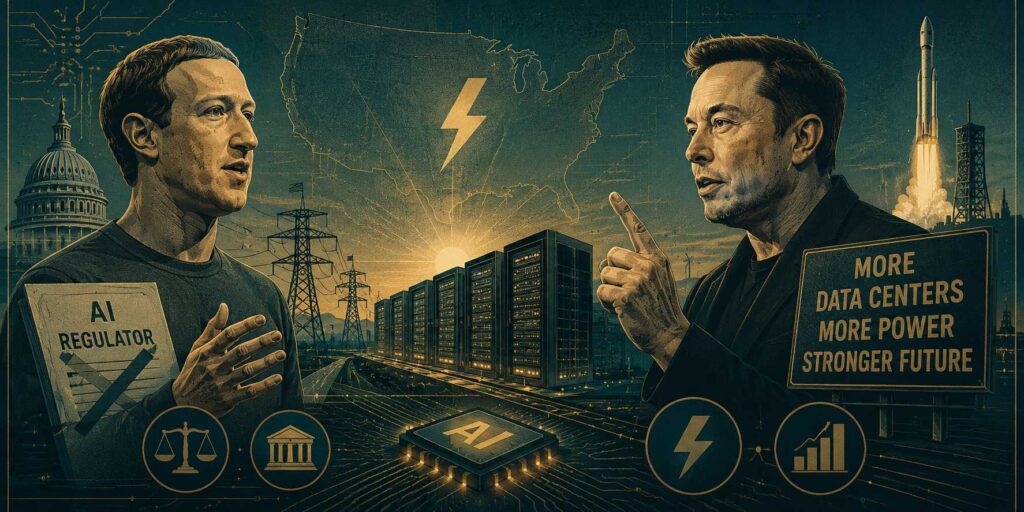
Meta CEO Mark Zuckerberg has privately pushed back against a proposed national AI regulator, while Tesla and SpaceX CEO Elon Musk has warned that the United States could face an electricity shortage as AI data centers rapidly expand.
The developments point to a broader divide over the future of the U.S. AI industry. Technology executives are urging policymakers to avoid rules that could slow development, while other artificial intelligence leaders and officials argue that increasingly capable models require stronger safety oversight.
Zuckerberg’s concerns emerged during a private phone conversation with President Donald Trump in August, according to reporting from POLITICO. Trump reportedly initiated the call during the week of August 17.
America’s AI Expansion Is Running Into an Energy Problem
Musk’s warning came as technology leaders gathered virtually for the G20 Innovation Ministerial in Chapel Hill, North Carolina.
Both Musk and Zuckerberg argued that the United States needs substantially more AI data centers and the electricity required to operate them. Zuckerberg highlighted the scale of the construction effort, saying the industry could require hundreds of thousands or even millions of skilled-trade workers.

For Musk, however, the bigger concern is electricity.
The Tesla and SpaceX chief warned that the rapid growth of artificial intelligence could create a significant power shortfall as soon as next year. He argued that insufficient energy capacity could undermine America’s ability to compete with China in artificial intelligence.
Musk has also predicted that artificial intelligence could expand the global economy by 20% to 30%, potentially representing an additional $20 trillion to $30 trillion in annual economic output.
The projections help explain why technology companies are pushing aggressively to expand computing capacity. More advanced AI systems require increasingly large clusters of specialized chips and data centers, making electricity availability a central issue for the industry.
Zuckerberg Questions Washington’s Proposed AI Watchdog
While Musk focused on infrastructure, Zuckerberg has been pressing the Trump administration on another potential obstacle to artificial intelligence expansion: regulation.
According to POLITICO, Zuckerberg told Trump that he opposed a proposal to establish a national artificial intelligence oversight organization modeled after the Financial Industry Regulatory Authority, or FINRA.

The proposed organization would potentially review advanced AI models and conduct safety testing before they were released more broadly. The concept has been promoted by Google DeepMind chief Demis Hassabis, who has argued for an industry-oriented standards body capable of addressing emerging artificial intelligence risks.
Zuckerberg reportedly stopped short of asking Trump to abandon the proposal. Instead, he argued that individuals appointed to such a body should reflect the president’s relatively light-touch philosophy toward AI regulation.
His position is consistent with comments made publicly in August. Zuckerberg has warned that policies capable of delaying the release of an artificial intelligence model could damage America’s competitive position against China.
The disagreement therefore extends beyond regulatory bureaucracy. At its core is a question over how much oversight the U.S. should impose on rapidly developingartificial intelligence systems without slowing the country’s technological progress.
White House Faces Competing AI Policy Models
The proposed regulator is not the only option being considered by the Trump administration.
Officials are reportedly weighing the FINRA-style framework against an alternative approach associated with White House adviser David Sacks.
Sacks has criticized the idea of creating another government regulatory body for artificial intelligence, arguing that it could become a bureaucratic bottleneck for developers. Instead, he has advocated an industry-led system modeled partly on the Motion Picture Association’s voluntary ratings framework.

Under that approach, technology companies could establish common standards without placing every new AI model through a formal government approval process.
The disagreement reflects a larger split within the artificial intelligence policy debate. Supporters of stronger oversight emphasize model safety, cybersecurity, and the potential for increasingly autonomous systems to cause harm. Industry advocates, meanwhile, argue that excessive regulation could slow innovation at a critical point in the U.S.-China technology competition.
The Trump administration has not yet abandoned the FINRA-style proposal, meaning both approaches remain part of the policy discussion.
Data Center Boom Meets Growing Local Opposition
The push for more AI infrastructure is also creating a political problem.
Large data centers require enormous quantities of electricity, and communities across the United States are increasingly questioning whether the economic benefits justify the strain on local infrastructure.
Concerns include higher electricity costs, environmental effects, water consumption, and noise generated by large facilities.
That resistance is becoming more significant as companies announce increasingly ambitious artificial intelligence infrastructure plans. Texas, in particular, has faced a surge in requests for new data-center power connections, prompting officials to scrutinize whether all proposed projects represent genuine demand.
Reuters reported that electricity requests tied to data centers across the United States have reached levels far above current consumption, raising concerns about speculative or unrealistic projects. Texas has responded by pausing some new grid connections and reviewing the legitimacy of proposed demand.
The situation creates a difficult balancing act for policymakers. artificial intelligence companies want abundant and inexpensive power to accelerate development, while regulators must ensure that infrastructure expansion does not destabilize electricity markets or shift high costs onto consumers.
AI Race Puts Regulation Power, and China in the Same Debate
The developments involving Zuckerberg and Musk ultimately point toward the same strategic challenge.
The United States wants to maintain its lead in artificial intelligence, but achieving that goal will require more than powerful models and advanced chips. The country also needs data centers, electricity, skilled workers, and a regulatory framework that companies believe will allow them to innovate quickly.
The Trump administration has increasingly favored a lighter-touch approach. At the G20 meeting, U.S. officials promoted principles encouraging countries to avoid broad new restrictions on artificial intelligence and to focus regulation on genuinely new circumstances.
At the same time, AI safety advocates continue to push for stronger testing and standards as autonomous systems become more capable.
That leaves Washington facing two related questions: how much oversight should powerful artificial intelligence systems receive, and how quickly should the physical infrastructure behind them be built?
For Zuckerberg and Musk, the answer appears to favor speed. Zuckerberg is warning against regulatory delays, while Musk is warning that the United States may not have enough electricity to support the next phase of the artificial intelligence boom.
Whether policymakers can satisfy both demands without creating new safety, energy, or political risks could shape America’s position in the global AI race for years to come.

Julia Thornton is a cryptocurrency reporter covering blockchain, digital assets, and financial technology. She reports on market developments, regulation, exchange activity, and industry trends, delivering timely and accurate coverage of the global crypto ecosystem.
View all stories by Julia Thornton →