 BTC
 ETH
 USDT
 BNB
 XRP
 USDC
 SOL
 TRX
 FIGR_HELOC
 ZEC
 HYPE
 DOGE
 XMR
 USDS

Jay Clayton’s New AI Role: What His SEC and XRP Past Says About Trump’s Tech Strategy

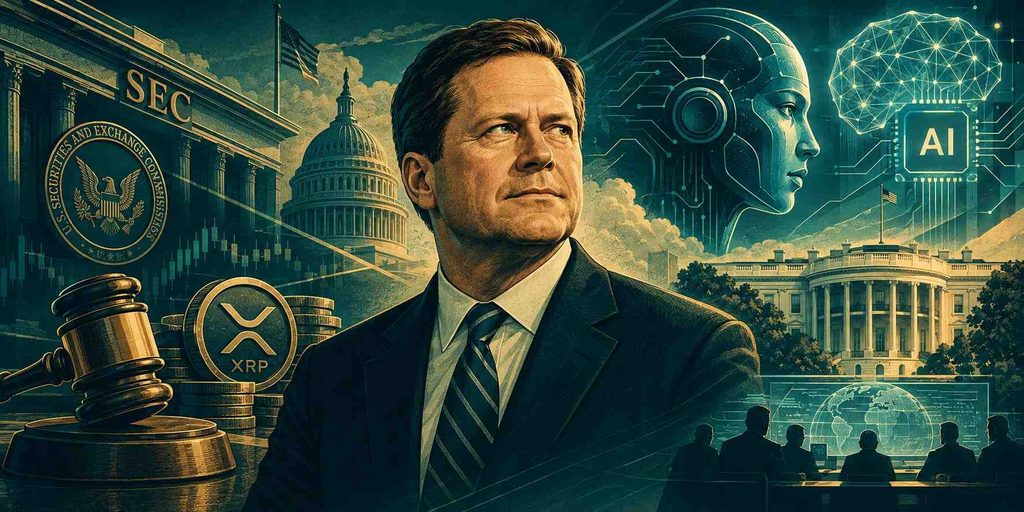
Jay Clayton is returning to the center of U.S. technology policy, but this time the subject is not securities markets or cryptocurrency.
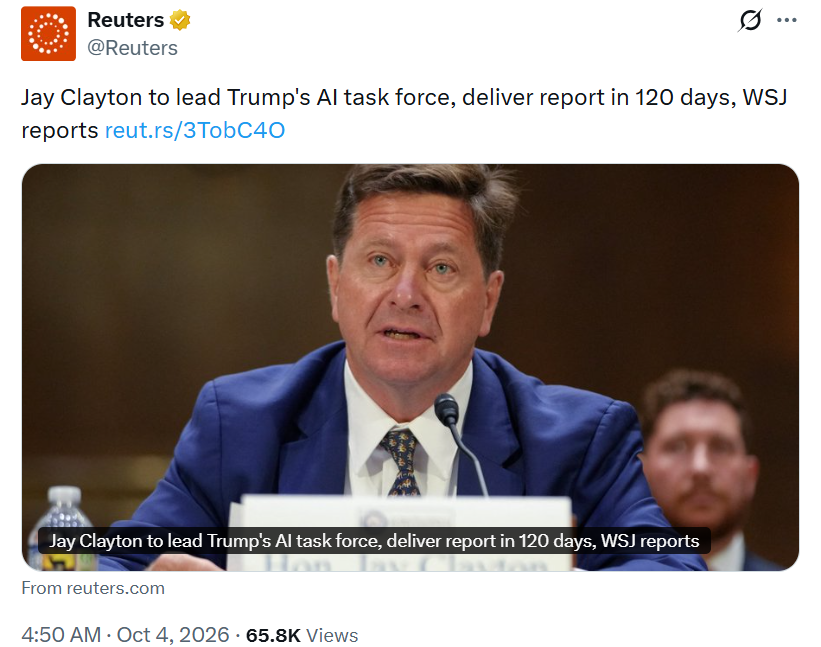
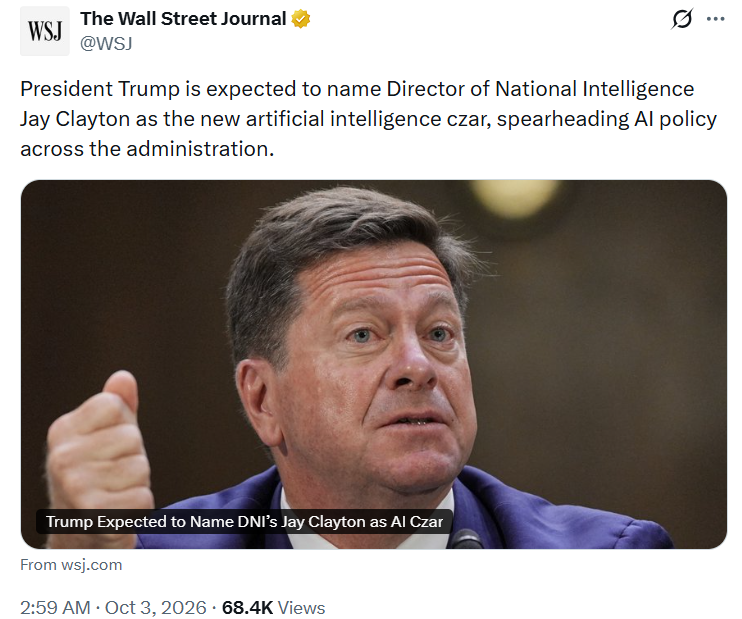
President Donald Trump has tapped Jay Clayton, the former SEC chairman and current Director of National Intelligence, to lead a new federal effort focused on advanced artificial intelligence.
Clayton will chair the White House’s “Super Intelligence Force,” a task force created to assess the opportunities and risks associated with increasingly capable AI systems. The group has 120 days to produce a report examining the government’s response and America’s position in the global race for advanced AI.
The appointment brings together two very different chapters of Clayton’s career. He previously headed the Securities and Exchange Commission during a period of rapid growth in digital assets, including the agency’s lawsuit against Ripple over XRP. He now faces questions involving AI development, national security, and U.S. technological competitiveness.
Trump’s AI Strategy Gets a New Coordinator
Clayton’s appointment expands his responsibilities without taking him away from his intelligence post. His position as DNI already places him at the center of U.S. national security policy, making AI a natural extension of his current portfolio.
The new task force will examine how the federal government should respond to the development of advanced AI and what measures may be needed to protect U.S. interests.
Vice President JD Vance and Defense Secretary Pete Hegseth are among the senior officials involved in the initiative. Former AI adviser David Sacks and former Secretary of State Condoleezza Rice are also part of the wider group advising the effort.
The administration has emphasized maintaining U.S. leadership as competition over AI capabilities intensifies, particularly in relation to China.
Rather than immediately pursuing sweeping regulation, the White House has shown a preference for voluntary safeguards and cooperation with the technology industry. Recent meetings with AI executives have included discussions around internal controls and independent reviews of AI models.
Clayton’s assignment will help determine what the administration considers an appropriate federal response as those systems become more powerful.
The SEC Chapter That Put Clayton on Crypto’s Map
Before becoming associated with AI and national security, Clayton was one of the most recognizable figures in U.S. financial regulation.
Trump appointed him SEC chairman in 2017. During his tenure, the agency confronted the rapid expansion of cryptocurrencies, initial coin offerings, and blockchain-based financial products.
His most consequential crypto decision came near the end of his term.
On December 22, 2020, the SEC sued Ripple Labs, alleging that the company and its executives had conducted an unregistered securities offering involving XRP. The regulator alleged that Ripple raised more than $1.3 billion through XRP sales.
Clayton left the SEC shortly after the lawsuit was filed, but his name remained closely connected with the case for years.
The litigation became a defining regulatory dispute for the cryptocurrency industry because it raised a fundamental question: under what circumstances can a digital token be treated as an investment contract and therefore fall under U.S. securities laws?
What Happened to the Ripple-XRP Case?
The legal battle eventually produced a more complicated picture than a simple win for either side.
In 2023, U.S. District Judge Analisa Torres ruled that certain institutional sales of XRP violated securities laws, while the programmatic sales at issue in the case did not constitute offers and sales of investment contracts under the circumstances presented.
The SEC continued its legal challenge, and the dispute remained an important reference point in debates over cryptocurrency regulation.
That history explains why Clayton’s new government position immediately attracted attention from XRP investors and crypto commentators.
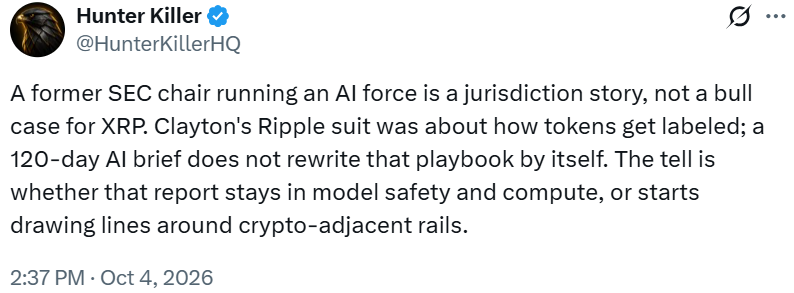
However, his appointment as AI czar should not be interpreted as a new XRP policy.
There is no indication that the Super Intelligence Force was established to revisit the Ripple case or develop a separate framework for XRP. Its stated mission centers on artificial intelligence, national security, and maintaining U.S. technological leadership.
From Wall Street Lawyer to National Security Official
Clayton’s professional background extends well beyond the SEC.
Before entering government, he spent more than two decades at Sullivan & Cromwell, working on corporate transactions, capital markets, and financial matters. His experience also included issues involving cybersecurity and emerging technologies.
After leaving the SEC, Clayton moved into federal law enforcement. He was nominated to become U.S. attorney for the Southern District of New York, one of the country’s most prominent federal prosecutor’s offices.
He later became Director of National Intelligence, giving him responsibility for coordinating the U.S. intelligence community.
That career path helps explain why the Trump administration selected him for an AI assignment that goes beyond technology policy alone.
Advanced AI increasingly intersects with intelligence gathering, cybersecurity, military capabilities, economic competition, and critical infrastructure. Those areas fall much closer to Clayton’s current responsibilities than the traditional role of a technology regulator.
Why the 120-Day AI Report Matters
The task force’s deadline gives the administration a relatively short window to assess a rapidly changing technology.
Its report is expected to examine both the potential benefits and dangers of advanced AI, along with the federal government’s ability to respond.
One of the central policy questions is how Washington can address genuine national security and safety concerns without imposing rules that undermine American competitiveness.
The administration has repeatedly emphasized the importance of keeping the United States ahead in AI development. That makes the task force more than a conventional regulatory review.
Its recommendations could influence how federal agencies approach AI safety, computing infrastructure, model development, and national security risks.
The report may also provide a clearer picture of whether voluntary industry commitments will remain the preferred approach or whether additional government measures could eventually be considered.
Could Clayton’s AI Role Affect Crypto?
The connection between Clayton and XRP is established by his SEC history, but extending that connection directly into his AI assignment would go beyond the available evidence.
For now, the two issues occupy separate policy tracks.
Still, the technology sectors are increasingly interconnected. AI is being used in financial services, cybersecurity, trading systems, and blockchain applications. At the same time, both AI and crypto face questions involving computing resources, data security, and rapidly evolving technology.
That creates potential areas of overlap without establishing that cryptocurrency regulation is part of Clayton’s current mandate.
For XRP holders, the more useful development to monitor is whether the administration eventually links AI policy with broader technology and financial regulation.
Any such shift would need to come through an explicit policy recommendation, regulatory action, or legislative proposal. Clayton’s appointment alone does not establish that connection.
A Different Role for a Familiar Regulatory Figure
Clayton’s move from the SEC to the intelligence community and now into Trump’s AI strategy highlights how quickly technology policy has expanded beyond traditional financial regulation.
His SEC tenure made him a central figure in the early U.S. regulatory battle over digital assets. His current position places him in a much wider national security framework.
The Super Intelligence Force will now test how that experience translates into AI policy.
For the cryptocurrency market, Clayton’s past ensures that his actions will receive close attention. But the immediate story is about artificial intelligence, not a new XRP enforcement campaign.
The 120-day report should offer the clearest indication of where the administration intends to take its AI strategy—and whether Clayton’s role remains focused on superintelligence, national security, and technological competition or eventually reaches into other emerging technology sectors.

Julia Thornton is a cryptocurrency reporter covering blockchain, digital assets, and financial technology. She reports on market developments, regulation, exchange activity, and industry trends, delivering timely and accurate coverage of the global crypto ecosystem.
View all stories by Julia Thornton →