 BTC
 ETH
 USDT
 BNB
 USDC
 XRP
 SOL
 TRX
 FIGR_HELOC
 ZEC
 HYPE
 DOGE
 XMR
 USDS

Goldman Sachs Restricts Claude Code and GitHub AI Tools Over Productivity and Risk Concerns
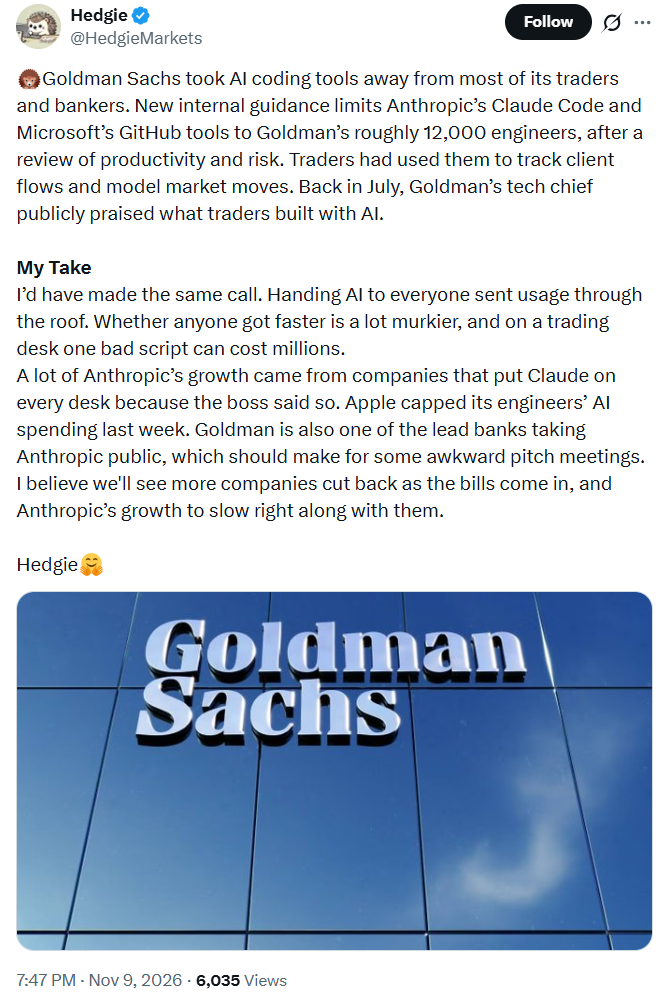
Goldman Sachs is tightening access to advanced artificial intelligence coding tools after an internal review raised questions about their productivity benefits and potential operational risks.


The Wall Street investment bank has restricted the use of Anthropic’s Claude Code and Microsoft’s GitHub coding tools, reserving access primarily for engineers and specialized quantitative teams while removing most traders and investment bankers from the programs.
The policy, outlined in internal guidance updated in October, marks a shift from the bank’s earlier approach of allowing employees across different departments to experiment with AI-assisted software development. Bloomberg first reported the changes on November 2, citing internal guidance and people familiar with the matter.
The decision reflects a broader challenge for financial institutions: determining how to capture the benefits of AI coding assistants without introducing unnecessary technical, financial, and data security risks.
Goldman Sachs Narrows Access to AI Coding Tools
Under the revised policy, Claude Code and GitHub’s AI coding capabilities are no longer generally available to traders and bankers. Access is largely concentrated among Goldman Sachs’ engineering workforce, which numbers approximately 12,000 employees, and certain quantitative specialists known as “strats.”
Strats operate at the intersection of financial markets, quantitative research, and software engineering. Their responsibilities often involve developing analytical systems and technical solutions for trading and investment activities. According to reporting by Bloomberg, the latest restrictions do not extend to this specialized group.
Before the policy change, employees outside the technology division had been using AI coding assistants for a range of workplace tasks. Traders, for example, relied on the tools to monitor client trading activity, evaluate potential market movements, model positions, and prepare written and visual materials.
For employees familiar with these applications, the restrictions have reportedly been frustrating. Some had incorporated AI-generated solutions into their daily workflows to complete technical tasks more quickly without depending entirely on dedicated engineering teams.
However, the bank’s latest decision suggests that widespread access alone was not enough to justify keeping the tools available across every department.
Productivity and Risk Management Drive the Decision
Goldman Sachs has not described the restrictions as a rejection of AI technology. Instead, the bank has emphasized the importance of evaluating whether individual tools deliver measurable benefits while remaining manageable from a risk perspective.
Nick Carcaterra, a spokesperson for Goldman Sachs, explained the firm’s approach to Bloomberg. He said the bank makes AI tools available to identify the “best use cases across different parts of the firm” and assesses factors including “productivity and risk management” before determining which employees should retain access.
The statement indicates that Goldman is moving toward a more selective approach to enterprise AI adoption. Rather than allowing unrestricted experimentation across departments, the bank appears to be prioritizing employees whose technical responsibilities and expertise are better suited to using advanced coding systems.
There are practical reasons for this caution. AI coding assistants can generate scripts, automate workflows, and help users build applications with limited programming experience. However, generated code still requires technical validation, particularly when it interacts with sensitive financial information or supports market-related activities.
A script may operate without displaying obvious errors while still relying on incorrect assumptions, processing information improperly, or producing misleading results. In financial services, such problems can have consequences beyond ordinary workplace inefficiency.
AI-generated applications may also introduce challenges involving access permissions, confidential client information, security controls, and compliance requirements. These considerations make human oversight and software testing especially important when automated tools are used in trading and banking environments.
Notably, public reporting has not identified a specific trading loss or confirmed AI-generated coding error that triggered Goldman’s decision. The stated rationale centers on the bank’s assessment of productivity and risk management rather than a publicly disclosed financial incident.
Decision Marks a Shift From Goldman’s Earlier AI Strategy
The restrictions represent a notable change from the approach Goldman Sachs was promoting earlier in 2026.
In July, Chief Information Officer Marco Argenti spoke positively about the growing use of AI-assisted development among employees without formal programming backgrounds. Traders and bankers were experimenting with what is commonly called “vibe coding,” using natural-language instructions to create software prototypes and practical workplace applications.
Under that approach, employees could develop initial solutions to problems they encountered in their daily responsibilities and then pass those applications to professional engineers for further development and refinement.
Goldman’s engineering workforce of approximately 12,000 provided the technical capacity to improve these early prototypes and prepare more reliable applications.
The model offered a potential advantage: employees closest to a business problem could experiment with solutions directly instead of waiting for dedicated technology teams to develop every initial concept.
The latest restrictions suggest that the bank’s subsequent evaluation identified limitations in applying this model across the wider workforce. Creating a working prototype does not necessarily mean that an application is secure, reliable, or suitable for production use.
This distinction is particularly important for financial institutions, where software must meet strict technical and operational requirements before it can support critical business activities.
Nevertheless, Goldman’s policy change should not be interpreted as a withdrawal from AI altogether. The bank has also developed an internal AI assistant that draws on models from companies including OpenAI, Anthropic, and Alphabet, according to Quartz. Its approach appears to involve greater control over how specialized AI capabilities are distributed and used.
Goldman’s Anthropic IPO Role Adds an Unusual Contrast
The timing of the decision is noteworthy because Goldman Sachs also holds a prominent position in Anthropic’s planned public offering.
Anthropic, the developer of Claude and Claude Code, filed its IPO paperwork on October 26, 2026. Goldman Sachs was named lead-left underwriter for the offering, placing the bank in a central role in the process. Morgan Stanley and other major financial institutions are also participating in the underwriting syndicate, according to reporting by Axios and Bloomberg Law.
This creates an interesting contrast. While Goldman is narrowing internal access to one of Anthropic’s prominent AI coding products, it is simultaneously playing a leading financial role in the company’s transition toward public markets.
However, the two developments involve different aspects of the relationship. The restrictions concern the bank’s internal use of AI software, while its IPO appointment concerns investment banking services. There is no reported indication that the access policy has affected Goldman’s underwriting role or its broader commercial relationship with Anthropic.
For Anthropic, the development nevertheless highlights an important consideration for enterprise AI providers. Strong interest in advanced coding products does not automatically translate into unrestricted adoption across large organizations. Financial institutions must also demonstrate that these products deliver measurable business value within established security and compliance frameworks.
A More Selective Approach to Enterprise AI Adoption
Goldman Sachs’ decision comes as financial institutions continue to evaluate how quickly they should integrate AI into everyday operations.
Banks are investing in AI systems to improve research, automate administrative work, support software development, and streamline internal processes. At the same time, they face growing pressure to ensure that these systems do not compromise data security, operational reliability, or regulatory responsibilities.
Other major financial institutions are also exploring different approaches. JPMorgan Chase, for example, has emphasized matching AI models to specific tasks rather than automatically using the most expensive systems for routine work. Its broader AI strategy also places importance on controlled access and oversight.
The challenge is not simply deciding whether employees should use AI. It is determining which employees need particular tools, what information those systems can access, and how their output should be checked before being used in business-critical applications.
Goldman’s latest restrictions illustrate this shift from broad experimentation toward more targeted deployment. They also raise questions about how enterprise software providers will demonstrate measurable returns as organizations become more selective about AI spending.
For Anthropic, the bank’s decision represents a significant example of how a major financial client is evaluating the practical limits of AI adoption. However, it is too early to conclude that the move signals a wider corporate retreat from Claude or other AI coding products.
The direction of enterprise AI adoption will likely depend less on how frequently employees use these tools and more on whether organizations can establish clear productivity gains, manageable costs, and reliable safeguards.
For Wall Street, the priority is increasingly clear: AI must support business performance without creating risks that outweigh its advantages.

Julia Thornton is a cryptocurrency reporter covering blockchain, digital assets, and financial technology. She reports on market developments, regulation, exchange activity, and industry trends, delivering timely and accurate coverage of the global crypto ecosystem.
View all stories by Julia Thornton →